
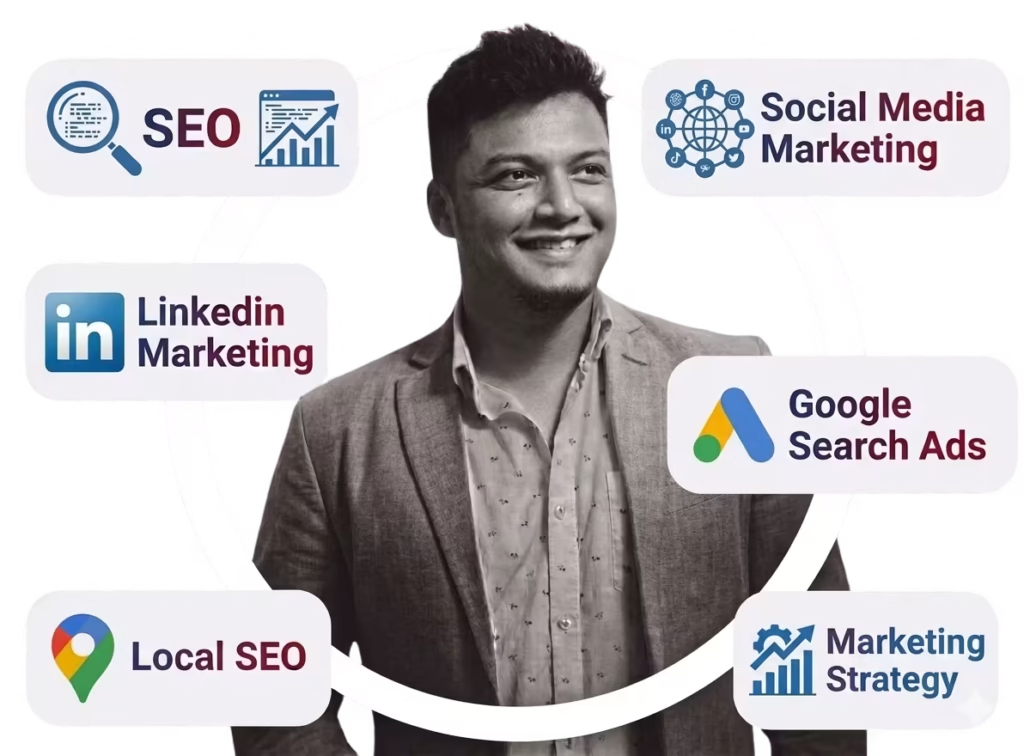
Digital Marketing Agency for Startups in Bangladesh – SkyWalk
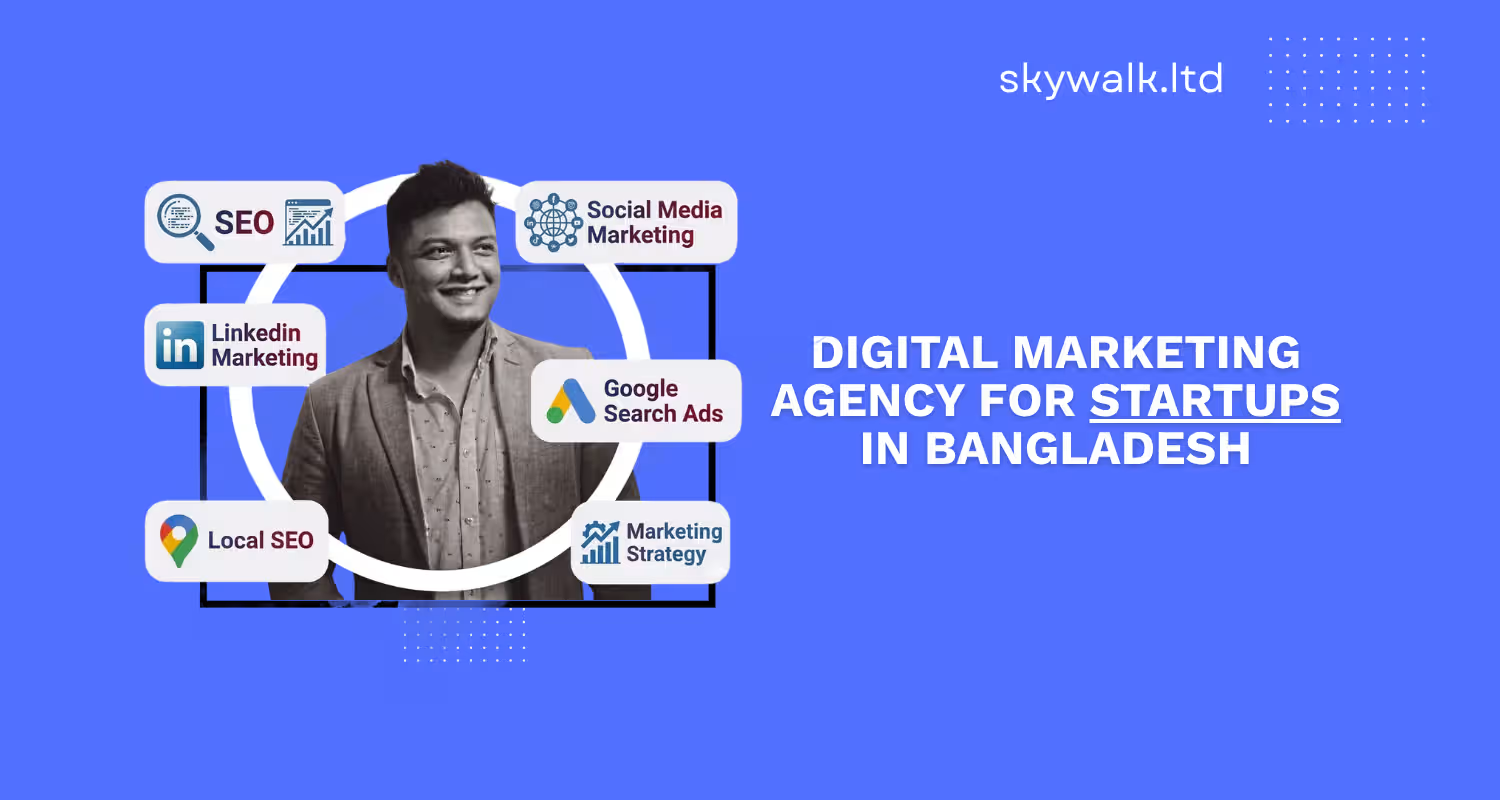
We are a dedicated digital marketing agency for startups in Bangladesh that helps startups to grow through practical digital marketing strategy, disciplined execution, and honest reporting. If you’re building a startup in Bangladesh, you already know that “running some Facebook ads” or “doing a bit of SEO” isn’t a growth strategy.
You’re juggling product, funding, hiring, operations, and market uncertainty. Marketing needs to work, but it also needs to be predictable, accountable, and tailored to the realities of a startup in Dhaka, Chattogram, or beyond.
SkyWalk is a digital marketing agency that works with startups and growing businesses to build customer acquisition systems, not just campaigns. We’ve spent years managing real budgets, fixing broken funnels, and helping founders turn scattered marketing experiments into measurable growth.
This page is written for founders who want practical clarity before hiring a startup marketing agency. You’ll see how we think, how we work, and what you should expect from any serious digital marketing partner in Bangladesh.
Marketing Agency for Startups in Bangladesh That Helps You Grow Faster
SkyWalk is a startup-focused digital marketing agency with teams in Bangladesh and the UK, working with startups, SMEs, ecommerce brands, and growth-focused companies since 2016.
From our experience, the startups that win are not the ones that spend the most—they’re the ones that turn marketing into a disciplined system: clear positioning, tested messaging, lean experiments, and consistent measurement tied to real business KPIs.
Why Startups Need a Startup-Focused Marketing Agency
Founders ask: “Why do I need a startup marketing agency? Can’t any digital marketing agency run my ads and SEO?”
On paper, any agency can set up campaigns. In practice, startups operate under different rules:
-
Your runway is limited. Every taka has to justify itself.
-
Your product and positioning are still evolving.
-
You don’t have a big brand to fall back on if campaigns fail.
-
You need learning speed as much as you need results.
How Startup-Focused Agencies Think Differently
From our campaigns, we’ve learned that startup marketing needs three things that generic agencies rarely prioritize:
-
Faster feedback loops (weekly, not quarterly).
-
Integrated thinking across SEO, ads, content, and product.
-
A bias toward experimentation, not just “best practices.”
We also see a recurring pattern: agencies treat startups like mini-enterprises—heavy on branding decks, light on revenue-focused experimentation. That’s where marketing budgets quietly die.
Comparison: Startup-Focused vs Generic Agency
| Dimension | Startup-Focused Marketing Agency (like SkyWalk) | Generic Digital Marketing Agency |
|---|---|---|
| Planning cadence | Weekly sprints, monthly reviews | Quarterly plans, long reports |
| Budget philosophy | Test → learn → scale | Fixed packages, rigid media plans |
| Positioning & messaging | Iterative, based on live customer feedback | One-time brand workshop |
| KPI focus | CAC, LTV, payback period, trial → paid conversion | Impressions, clicks, followers |
| Channel selection | Starts with ICP & funnel, then picks channels | Sells pre-set services |
| Founder involvement | Working sessions, shared dashboards | Monthly report email |
Founder Tip:
If an agency can’t explain how they’d adjust your strategy when your product or pricing changes, they’re not thinking like a startup partner. This is why every startup business needs a specialized digital marketing agency.
Our Startup Growth Framework
Founders ask: “What’s your approach? How will you actually grow my startup?”
We don’t start with channels. We start with a simple question:
“What does success look like for this startup, at this stage, in this market?”
From our work with startups in Bangladesh and abroad, we use a practical growth framework built around five pillars:
-
Foundation – Positioning, ICP (ideal customer profile), offer, pricing, messaging.
-
Acquisition – SEO, Google Ads, Facebook/Instagram Ads, content, partnerships.
-
Activation – Landing pages, onboarding flows, email sequences, product tours.
-
Revenue & Retention – Conversion to paid, upsells, churn reduction, loyalty.
-
Measurement & Iteration – Analytics, dashboards, cohort analysis, A/B tests.
The North Star Metric
Every startup needs a clear North Star metric. For some, it’s “new qualified demos per month.” For others, it’s “first purchases,” “new trial signups,” or “bookings from Bangladesh-based customers.”
We work with founders to pick one North Star metric and 3–5 supporting KPIs that reflect real business progress, not vanity numbers.
Example KPIs:
-
Cost per qualified lead (CPL)
-
Customer acquisition cost (CAC)
-
Trial-to-paid conversion rate (for SaaS)
-
Repeat purchase rate (for ecommerce)
-
Booking completion rate (for hospitality)
How Campaigns Evolve Over Time
Our campaigns typically move through three phases:
-
Phase 1 – Discovery:
-
Clarify ICP and positioning.
-
Audit current funnels, ads, and content.
-
Launch small, tightly scoped experiments.
-
-
Phase 2 – Validation:
-
Double down on promising segments and messages.
-
Refine landing pages and onboarding.
-
Cut channels that don’t contribute to core KPIs.
-
-
Phase 3 – Scale:
-
Increase budgets where unit economics are healthy.
-
Layer in new channels once the core funnel is stable.
-
Build growth loops (referrals, content, community).
-
Expert Note:
The goal isn’t “doing more marketing.” The goal is building a system where each incremental taka has a clear role in moving a specific metric.
Startup Digital Marketing Services
Founders ask: “What exactly will you do for us?”
SkyWalk offers a full stack of startup marketing services so you’re not piecing together five different vendors.
Core Startup Marketing Services
-
Startup SEO agency services
Technical SEO, content strategy, on-page optimization, link earning campaigns.
-
Google Ads for startups
Search, Performance Max, Display, YouTube; focused on high-intent keywords and clear tracking.
-
Facebook & Instagram Ads
Prospecting and retargeting, creative testing, lead generation funnels.
-
Startup content marketing
Blog content, landing pages, case studies, email sequences, lead magnets.
-
Startup branding & positioning
Brand narrative, visual identity, messaging frameworks.
-
Startup website design & CRO
Landing page design, UX improvements, conversion rate optimization.
-
Analytics & performance marketing
Tracking setup, dashboards, weekly performance reviews.
Matching Services to Startup Stage
| Startup Stage | Priority Services |
|---|---|
| Pre-seed / idea | Positioning, branding, landing page, early SEO |
| Seed / early traction | SEO, Google Ads, Facebook Ads, CRO, analytics setup |
| Post–PMF scale | Performance marketing, content engine, advanced SEO |
| Established growth | Multi-channel growth, brand building, retention |
We don’t push every service on day one. We choose the smallest set of actions that can move the right KPIs within your budget and timeline.
Startup Marketing Strategy
Founders ask: “Can you help us with the strategy, not just execution?”
Yes. Our best work happens when we’re involved in your strategic decisions, not just “running campaigns.”
How We Build a Startup Marketing Strategy
From our experience, a useful startup marketing strategy answers five questions:
-
Who are we for?
-
Clear ICPs: geography, role, industry, pain points.
-
-
What problem do we solve best?
-
One primary problem, two secondary ones. No generic “we do everything.”
-
-
Why should someone choose us now?
-
Time-sensitive triggers: new regulation, trend, economic shift, or market gap.
-
-
Where will we find these customers?
-
Channels: search, social, communities, events, partnerships.
-
-
How will we measure progress?
-
KPIs for each funnel stage: awareness, consideration, conversion, retention.
-
We translate these answers into a practical plan:
-
90-day roadmap (experiments and priorities).
-
Channel mix and budget ranges.
-
Content and creative themes.
-
Dashboard metrics and meeting cadence.
Traffic Without Positioning Fails
A mistake we see often: founders focus on “getting more traffic” without fixing positioning.
When positioning is vague (“we do quality services at affordable prices”), every click is expensive because:
-
Prospects can’t tell why they should choose you.
-
Ad platforms optimize for clicks, not understanding.
-
Landing pages feel generic, so conversion rates stay low.
We’ve learned that even a small improvement in positioning—being specific about niche, outcome, and proof—often increases conversion more than doubling the traffic.
Customer Acquisition System
Founders ask: “Can you help us build a repeatable customer acquisition system?”
That’s the core of our work. We treat customer acquisition as a system with clear inputs, steps, and outputs.
Components of a Startup Customer Acquisition System
-
Clear offer
What exactly are you selling, to whom, at what price, with what promise.
-
Qualified traffic
SEO, Google Ads, Meta Ads, content, and referral channels.
-
Conversion assets
Landing pages, forms, product tours, demos, and follow-up flows.
-
Nurture and trust
Email, retargeting, social proof, content that answers objections.
-
Measurement & optimization
Analytics, event tracking, funnel reports, experiments.
Sample Acquisition Flow
-
Prospect searches “inventory management software for SME in Bangladesh.”
-
Google Ad appears with a specific message and local angle.
-
Prospect lands on a page explaining the product in simple language, with a demo option.
-
Prospect books a demo; automated confirmation and reminders go out.
-
Sales call happens; decision tracked in CRM.
-
If not converted, retargeting and follow-up emails continue with helpful content.
We design these flows channel by channel, then connect them into one consistent acquisition system.
KPIs We Watch
-
Cost per qualified lead (CPL)
-
Lead-to-opportunity rate
-
Opportunity-to-customer rate
-
CAC and payback period
-
Bounce rate and session depth
-
Time-to-first-value (for SaaS)
Founder Checklist: Is Your Acquisition System Healthy?
-
You know your CPL and CAC by channel.
-
You can see where leads drop off in the funnel.
-
You have at least one proven message–audience–offer combo.
-
You run experiments every month, not once per year.
If you don’t have these, you don’t have a system yet—you have campaigns.
Startup SEO Services
Founders ask: “When should we start SEO? Is it worth it for a startup?”
From our experience, startups that treat SEO as a long-term asset, not a quick hack, get the most value.
When SEO Should Start
We usually recommend starting SEO when:
-
Your product and positioning are reasonably stable.
-
You’ve identified key problems your audience searches for.
-
You can commit to content creation for at least 6–12 months.
SEO is not the best primary acquisition channel when:
-
You’re still validating your core problem and audience.
-
You need customers this month to survive.
-
Your product is very niche with low search volume.
What Our Startup SEO Agency Does
-
Technical SEO audit
Fix crawl issues, speed, mobile usability, indexation.
-
Keyword & topic mapping
Map keywords to funnel stages (awareness, consideration, decision).
-
On-page optimization
Meta tags, headings, internal links, content structure.
-
Content strategy
Blog posts, guides, comparison pages, solution pages.
-
Local and industry-specific SEO
For Bangladeshi startups targeting local search.
-
Analytics & Search Console monitoring
Track rankings, CTR, impression trends.
We follow Google’s guidance on helpful, people-first content and E-E-A-T (Experience, Expertise, Authoritativeness, Trustworthiness), making sure content is written for humans and backed by real expertise.
Why Startups Fail with SEO
Common patterns we’ve seen:
-
Publishing thin, generic content that doesn’t help anyone.
-
Writing for keywords instead of customer questions.
-
Treating SEO as “set and forget.”
-
Ignoring technical issues that block growth.
-
Not connecting content performance to leads and revenue.
As an SEO agency for startups in Bangladesh, we build SEO programs that answer real founder questions and user problems, then connect those pages to your funnel.
Google Ads for Startups
Founders ask: “We tried Google Ads, burned money, and got nothing. What went wrong?”
We’ve audited many startup accounts where Google Ads failed not because the channel was bad, but because the strategy was misaligned.
When Google Ads Make Sense
Google Ads work best when:
-
Your audience is actively searching for solutions.
-
You have clear offers and landing pages.
-
You can track conversions (leads, demos, purchases) accurately.
They’re risky when:
-
You’re guessing keywords without research.
-
You send all traffic to the homepage.
-
You don’t have clear differentiation in your ad copy.
How We Run Google Ads for Startups
-
Keyword strategy:
-
Focus on high-intent search terms close to buying decisions.
-
Exclude irrelevant queries with negative keywords.
-
-
Campaign structure:
-
Separate brand, generic, and competitor campaigns.
-
Use tight ad groups with coherent themes.
-
-
Creative & messaging:
-
Address local context, industry pains, and clear outcomes.
-
Integrate trust signals: testimonials, certifications, guarantees (when real).
-
-
Landing pages:
-
Match search intent.
-
Clear offer, simple form, proof, and next steps.
-
-
Optimization:
-
Regular search term reviews.
-
Bid and budget adjustments based on CAC and conversion data.
-
Warning:
Google Ads don’t fix weak positioning or broken landing pages. If those are weak, the platform simply makes your weaknesses more expensive.
Facebook Ads for Startups
Founders ask: “We boosted posts on Facebook. Why didn’t it turn into customers?”
We’ve learned that “boosting posts” rarely leads to predictable growth. Facebook and Instagram Ads require deliberate strategy.
Why Startups Fail with Facebook Ads
Patterns we see:
-
Targeting is too broad or too random.
-
Creative is focused on features, not outcomes.
-
There’s no proper landing page—just sending traffic to the homepage or inbox.
-
No follow-up systems: retargeting, email, or sales process.
How We Use Facebook Ads for Startups
-
Audience strategy:
-
Interest, lookalike, and custom audiences based on real customer data.
-
Segmentation by stage: cold vs warm vs hot.
-
-
Creative testing:
-
Multiple angles: problem-focused, outcome-focused, social proof, offers.
-
Systematic testing rather than random changes.
-
-
Funnel design:
-
Lead magnet → nurture sequence → offer.
-
Direct response campaigns for simple offers.
-
-
Retargeting:
-
Website visitors, video viewers, engaged users.
-
Dynamic product ads for ecommerce.
-
We treat Facebook Ads as part of your acquisition system, not a standalone activity.
Startup Branding
Founders ask: “Do we need branding now, or should we focus only on performance marketing?”
Branding and performance marketing are not opposites. For startups, branding is about clarity and trust, not expensive TV campaigns.
Minimum Viable Brand for a Startup
From our experience, early-stage startups need:
-
A clear brand narrative: who you are, why you exist, who you serve.
-
Simple, consistent visual identity: logo, colors, typography.
-
A messaging system: 2–3 key messages repeated across channels.
-
Basic brand guidelines: how to talk, what to avoid, how to show up online.
We help founders define brand elements that support performance marketing, not fight it.
Why Traffic Without Branding Struggles
When your brand is unclear:
-
Ads feel disconnected from your website.
-
Prospects can’t remember you after one interaction.
-
Referral and word-of-mouth growth are weaker.
We’ve seen that even modest improvements in brand clarity—consistent visuals, sharper narrative—often increase trust and campaign performance.
Startup Website Optimization
Founders ask: “Our website looks fine. Why isn’t it converting?”
We’ve audited many startup websites where design isn’t the main problem. Clarity and friction are.
What We Look For in Startup CRO
-
Does the hero section explain what you do in plain language?
-
Is there a clear primary CTA (book demo, start trial, get quote)?
-
Are benefits and outcomes more prominent than features?
-
Is the form asking for more than it needs?
-
Are trust signals visible (real testimonials, logos, case snippets)?
We treat your website as a conversion engine, not just a brochure.
Typical Optimization Wins
-
Rewrite hero copy for clarity and specific outcomes.
-
Reduce form fields and add microcopy for reassurance.
-
Improve mobile experience for Bangladeshi users on slower connections.
-
Add relevant social proof and case highlights.
-
Create dedicated landing pages for each core campaign.
Chart Idea:
We often show founders a simple chart of “conversion rate before vs after key changes” so you can see which improvements actually moved the needle. This kind of visualization also helps teams understand why UX and messaging matter.
Startup Marketing Budget Guide
Founders ask: “How much should we spend on marketing? What’s realistic for a startup in Bangladesh?”
We can’t give a single number that fits everyone, but we can share frameworks and examples.
Principles for Startup Marketing Budgets
-
Start small, learn fast, then scale.
-
Tie budgets to stage and goals, not trends.
-
Protect a portion of the budget for experimentation.
-
Avoid committing to long, rigid retainers until your funnel is more stable.
Example Monthly Budget Scenarios (Illustrative Only)
These are examples to show how we think about allocation, not fixed rules. Exact numbers depend on your industry, pricing, and goals.
Scenario A – Early-Stage Service Startup (Bangladesh)
-
Total marketing budget: modest monthly amount.
-
Allocation example:
-
30% – Google Ads for high-intent leads.
-
30% – Facebook/Instagram lead generation campaigns.
-
20% – Content and SEO groundwork.
-
20% – Website optimization and analytics.
-
Scenario B – SaaS Startup with Seed Funding
-
Total marketing budget: higher, tuned to CAC/LTV targets.
-
Allocation example:
-
35% – Google Ads (search and remarketing).
-
25% – LinkedIn or Meta Ads (depending on ICP).
-
20% – SEO and content marketing.
-
10% – CRO and onboarding optimization.
-
10% – Experiments (new channels, creatives, offers).
-
Budget Decision Framework
Ask these questions:
-
What’s our target CAC, and what can we afford based on LTV?
-
How quickly do we need results to validate this stage?
-
Which channel has the best early signal for us so far?
-
How much can we invest in learning versus pure acquisition?
We work with you to build a realistic budget plan, then adjust every few months based on performance, not guesswork.
Startup Growth Stages
Founders ask: “What should we focus on at our current stage?”
From our campaigns, we’ve seen that trying to do “scale-up” marketing at the “idea” stage is a common way to waste money.
Growth Stages and Marketing Priorities
| Stage | Description | Marketing Focus |
|---|---|---|
| Idea / Pre-launch | Concept, prototypes, early interviews | Positioning, ICP, landing page, small tests |
| Launch | First customers, early revenue | Direct response campaigns, simple funnels |
| Early traction | Repeat customers, some retention | SEO foundation, better funnels, retention tactics |
| Product–market fit | Strong demand, clear value | Aggressive acquisition, content engine, CRO |
| Scale-up | Larger budgets, multi-country growth | Multi-channel strategy, brand building, growth loops |
Chart Idea:
We often map your KPIs (leads, conversion rate, CAC, retention) against these stages in a line chart to show where you are now and what “healthy” looks like at the next stage.
Industries We Help
Founders ask: “Do you have experience in our industry?”
SkyWalk has worked with startups, SMEs, ecommerce businesses, hospitality brands, and various growth-focused companies in Bangladesh and other markets.
While every business is different, we’ve seen strong fits with:
-
Technology & SaaS startups
-
Ecommerce and D2C brands
-
Hospitality and travel
(hotels, resorts, booking platforms)
-
Local service businesses
(clinics, training centers, agencies)
- Education and EdTech
(school, colleges, universities, online course platforms) -
Professional services
(consulting, legal, finance)
We don’t claim experience in every industry. If your space is new to us, we’ll say so, then show you how we’d build a research and testing plan before scaling.
Startup Case Studies
Founders ask: “Can you show examples of what you’ve done?”
We don’t publish every client story publicly, and we don’t invent case studies. Instead, here are anonymized patterns based on real workflows and decisions, without sharing sensitive data.
Example 1 – SaaS Startup with High CAC
A Bangladesh-based SaaS startup was acquiring users through outbound and occasional ads, but CAC was high and conversion from trial to paid was low.
What we did (methodology):
-
Audited their funnel from ad click to onboarding.
-
Identified one niche segment where activation rates were much higher.
-
Repositioned campaigns and content around that segment’s specific pains.
-
Simplified trial onboarding and added one guided tour.
-
Shifted budget from broad campaigns to focused, high-intent keywords and audiences.
Result pattern:
-
Better trial quality.
-
Higher trial-to-paid conversion.
-
Lower CAC in that segment, making the acquisition model more sustainable.
Exact numbers vary by client, but the principle holds: focus on segments where unit economics work, then scale those.
Example 2 – Service Business with Unclear Positioning
A local service startup was running Facebook Ads to “everyone” with generic copy like “Quality services at affordable prices.” Leads were poor, and most people didn’t understand what they actually did.
What we did:
-
Clarified their top three profitable services and target industries.
-
Rewrote messaging to speak directly to those industries’ pain points.
-
Built dedicated landing pages for each core service.
-
Set up Facebook and Google campaigns targeting those segments.
Pattern we saw:
-
Fewer but better leads.
-
Higher close rates.
-
Less founder frustration with “random inquiries.”
We’ll gladly walk you through specific examples during a consultation, with the level of detail we’re allowed to share.
Our Marketing Process
Founders ask: “What will working with SkyWalk look like week to week?”
We’ve learned that process transparency is key to trust. Here’s how we typically work with startups.
Step-by-Step Workflow
-
Discovery & Audit
-
Understand your product, market, goals, and constraints.
-
Audit existing assets: website, ads, SEO, analytics, CRM.
-
-
Strategy & Roadmap
-
Define ICPs, positioning, North Star metric, and priority KPIs.
-
Build a 90-day roadmap with clear experiments and actions.
-
-
Setup & Foundations
-
Fix tracking (GA4, pixel, events).
-
Create or improve core landing pages.
-
Ensure brand and messaging consistency.
-
-
Launch Priority Campaigns
-
Start with a lean but high-focus channel mix (e.g., Google Ads + Meta Ads + key SEO pages).
-
Set up dashboards and reporting.
-
-
Weekly Optimization
-
Review performance.
-
Adjust bids, audiences, creatives, and landing pages.
-
Document learnings.
-
-
Monthly Strategy Review
-
Assess progress vs KPIs.
-
Re-prioritize experiments and channels.
-
Make decisions about scaling or cutting campaigns.
-
-
Quarterly Growth Planning
-
Update strategy based on results and business changes.
-
Plan new initiatives: content series, brand campaigns, new channels, retention programs.
-
Founder Tip:
Ask any agency, “What will happen in the first 90 days?” If they can’t give a detailed answer, you’re buying a promise, not a process.
Marketing Tools We Use
Founders ask: “What tools will you use to manage and track our marketing?”
We use a mix of standard and specialized tools to support performance marketing for startups.
Typical Tool Stack
-
Analytics & tracking
-
Google Analytics 4 (GA4)
-
Google Tag Manager (GTM)
-
Google Search Console
-
-
Advertising platforms
-
Google Ads
-
Meta Ads (Facebook, Instagram)
-
-
Website & CRO tools
-
CMS platforms (WordPress, Shopify, custom builds)
-
Heatmap/recording tools (where appropriate)
-
-
Communication & CRM
-
Email platforms (e.g., Mailchimp, similar tools)
-
CRM systems (depending on your stack)
-
We’ll work with your existing tools where possible and recommend changes only when they clearly improve measurement or execution.
Startup Marketing Mistakes
Founders ask: “What are the common mistakes we should avoid?”
After working with many startups, we see the same mistakes again and again.
Common Mistakes We See
-
Copying enterprise marketing
-
Long, vague decks, generic brand campaigns, no clear offers.
-
-
No measurement discipline
-
Tracking only clicks and likes, not leads, demos, and revenue.
-
-
Starting too many channels at once
-
Thin focus, no depth in any channel.
-
-
Ignoring positioning and messaging
-
“We serve everyone,” so no one understands why they should choose you.
-
-
Treating marketing as a one-time project
-
No iterative experimentation and learning.
-
Why Founders Waste Marketing Budgets
In our experience, budgets are wasted when:
-
Decisions are made on gut feel instead of data.
-
Agencies aren’t transparent about performance and tradeoffs.
-
Founders buy “packages” instead of outcomes and processes.
We help you avoid these traps by making decisions based on data, realistic expectations, and clear communication.
Frequently Asked Questions
Founders ask many of the questions below when considering a startup marketing agency. Here are concise, practical answers.
1. Do you guarantee rankings or revenue?
No. We don’t guarantee specific rankings or revenue because every startup is different—industry, competition, product quality, pricing, and market timing all matter.
What we do commit to is a disciplined process, transparent reporting, and strategy decisions based on data, not hype.
2. How long before we see results?
It depends on the channels and your stage:
-
Performance marketing (Google Ads, Facebook Ads): weeks to start seeing signals, a few months to stabilize.
-
SEO: usually 3–6+ months to see meaningful movement, depending on competition and content cadence.
-
Branding and positioning: sometimes immediate impact on conversion and sales conversations.
We’ll give you realistic timelines during the consultation, based on your situation.
3. Do you work with pre-seed or bootstrapped startups?
Yes, we do, but we’re honest about what’s realistic at that stage. For very early startups, we often recommend:
-
Lean experiments.
-
Focused channels.
-
Smaller budgets concentrated on learning.
If we think you’re not ready for an agency yet, we’ll say so and suggest what to do first.
4. Can you work with our in-house marketing team?
Absolutely. We often act as an extension of your team, providing:
-
Strategy and frameworks.
-
Channel management and optimization.
-
Training and dashboards.
We’re comfortable integrating with your existing workflows and tools.
5. How do you measure success?
We choose KPIs together based on your model:
-
Leads, demos, trials, or bookings.
-
CAC, LTV, and payback period.
-
Conversion rates at key funnel stages.
We review these metrics regularly and adjust your strategy accordingly.
6. Are you based in Bangladesh?
Yes. SkyWalk has a presence in Dhaka (Gulshan Niketon) and serves clients across Bangladesh and other regions.
7. When should a startup hire an agency vs do it in-house?
Hire an agency when:
-
You need specialized skills you can’t afford to hire full-time yet.
-
You want systems and strategy, not just task execution.
Stay in-house (for now) when:
-
You’re still validating your core idea and problem.
-
You don’t have basic positioning or an initial website in place.
We’ll be candid about whether now is the right time for you. Lot of startup brands don’t understand that, real cost is not hiring a digital marketing agency, it is about not understanding the need of it.
Book a Startup Growth Consultation
Founders ask: “What happens if we schedule a consultation?”
Here’s what you can expect from a consultation with SkyWalk:
-
A focused conversation about your startup, goals, and challenges.
-
A quick audit of your current marketing, funnels, and KPIs.
-
Practical recommendations on what to do in the next 90 days.
-
An honest assessment of whether working together makes sense right now.
We won’t promise overnight success or “guaranteed results.” Instead, we’ll show you how we think, how we decide, and how we build startup marketing systems that can actually be measured and improved.
If you’re a founder, co-founder, or growth owner building a startup in Bangladesh and you want predictable, disciplined marketing—not just more campaigns—book a startup growth consultation with SkyWalk.
You’ll leave with more clarity, whether we work together or not.
Contact: SkyWalk- digital marketing agency for startups in Bangladesh
Address: House 21, Niketon Rd 06, Dhaka 1212
Phone no: 01706005905
Sources and referrences:
- https://developers.google.com/search/docs/fundamentals/creating-helpful-content
- https://developers.google.com/search/blog/2022/12/google-raters-guidelines-e-e-a-t
- https://www.facebook.com/skywalkltd/
- https://www.designrush.com/agency/profile/skywalk
- https://www.linkedin.com/company/skywalk-solutions
- https://developers.google.com/search/blog/2022/12/google-raters-guidelines-e-e-a-t?hl=ru
- https://startlaunchbd.com/
- https://stripe.com/resources/more/marketing-tactics-for-startups
- https://mailchimp.com/resources/startup-marketing-strategy/
- https://www.salesforce.com/blog/small-business/ai-marketing-strategies-for-startups/
- https://www.upwork.com/resources/startup-marketing-strategies