
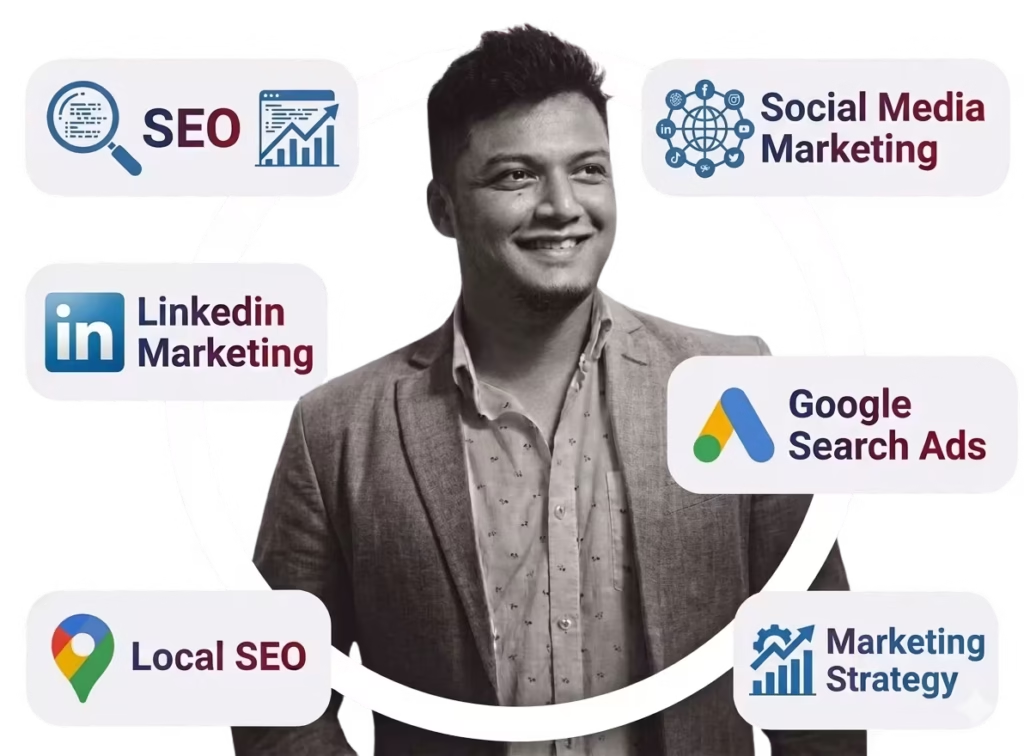
Best Digital Marketing Agency for Ecommerce in Bangladesh – SkyWalk
We are a dedicated and best digital marketing agency for ecommerce in Bangladesh that helps online stores grow sales through practical digital marketing strategy, disciplined execution, and honest reporting. Our team has spent years inside real Bangladeshi ecommerce businesses, fixing tracking, rebuilding product pages, and scaling profitably across SEO, Google Ads, Meta Ads, and CRO.
Why Bangladesh ecommerce needs a specialized agency
Bangladesh’s ecommerce market is growing fast, driven by mobile-first shoppers, social commerce, and improving logistics and payments. At the same time, cash-on-delivery and trust issues make conversion and retention harder than in many other markets.
We’ve worked with stores that had strong demand but weak systems: missing GA4 ecommerce tracking, no product feed structure, slow mobile sites, and ad accounts where 80% of spend went to broad campaigns with no margin control. Those businesses didn’t need “more traffic”; they needed better measurement and sharper decisions.
A generalist agency can get you impressions and clicks. A true ecommerce marketing agency for Bangladesh focuses on:
Turning visits into orders and repeat buyers.
Making sure every channel respects your margins and inventory reality.
Building systems that survive platform changes, seasonality, and cash-flow pressure.
When Google folded the Helpful Content System into its core ranking systems, it became clear that ecommerce sites need deeper, more user-focused content — not just keyword-stuffed category pages. For Bangladeshi stores, this means product pages, buying guides, FAQs, and policies that truly answer customer questions about delivery, returns, COD, and authenticity. This is why every ecommerce business needs a specialized digital marketing agency.
Who we work with in Bangladesh ecommerce
We mainly work with:
Shopify stores selling fashion, electronics, beauty, home, and niche categories.
WooCommerce and custom sites that started as small catalog sites and now need serious scaling.
Daraz sellers who want to move beyond marketplace dependence and build their own brand assets.
Brands and manufacturers shifting from wholesale/retail into direct-to-consumer ecommerce.
In each case, we’ve seen the same core problems:
Over-reliance on Facebook boosts and broad Google campaigns without proper tracking.
No separation between testing budgets and scaling budgets.
No clear view of ROAS, CAC, LTV, or true profit after discounts and returns.
Our work is not about “doing SEO” or “running ads” in isolation. It’s about building an ecommerce growth engine that fits the Bangladesh context: mobile-heavy traffic, COD expectations, festival peaks, and the reality that many customers still compare prices across Daraz, Facebook pages, and standalone sites before ordering.

Our ecommerce growth framework
We use a simple but disciplined framework for every ecommerce client for digital marketing, regardless of size:
Diagnose – understand the numbers, systems, and bottlenecks.
Design – choose the right channel mix, structure, and offers.
Deploy – launch campaigns, fix pages, and set up measurement.
Optimize – continuously improve based on data and real customer behaviour.
Scale – only scale what is proven to be profitable and sustainable.
Step 1 – Market & data audit
Before touching your campaigns, we audit:
GA4 and ecommerce tracking (view item, add to cart, begin checkout, purchase).
Meta Pixel / Conversion API implementation and event mapping.
Google Ads conversion actions, enhanced conversions, and audience lists.
Product feed quality (titles, descriptions, attributes, images, GTIN/brand if available).
Site speed, Core Web Vitals, and mobile UX.
Google’s documentation makes it clear that helpful, trustworthy content and good page experience are key inputs for ranking systems. We’ve seen campaigns where Google Ads looked “bad” simply because GA4 wasn’t correctly attributing sales to the right channels. Fixing measurement usually changes the story.
Common issues we find:
One global “purchase” event firing on every form submission.
No separation between COD and prepaid orders in the data.
Broken cross-domain tracking (store and blog measured separately).
Without a clean baseline, every budget decision is guesswork. So we fix tracking first.
Step 2 – Growth strategy & channel mix
When creating digital marketing strategy for ecommerce in Bangladesh, we create growth goals with you: revenue, profit, inventory clearance, or market share in specific categories. Then we choose a channel mix across SEO, Google Ads, Meta Ads, TikTok Ads, and email/SMS that fits your cash-flow and margin reality.
Lessons we’ve learned in Bangladesh:
If your supply chain is unstable, aggressive Performance Max or broad Facebook campaigns can create customer service disasters.
For COD-heavy businesses, over-scaling too quickly leads to high cancellation and return rates that kill profit.
For new brands, retargeting, content, and email often stabilize CAC faster than pure prospecting.
We build scenarios: conservative, balanced, and aggressive. You see the trade-offs before spending.
Step 3 – Execution, testing & scaling
Execution is where most campaigns fail — not because the idea is wrong, but because testing is random and structure is messy.
Our approach:
Start with a limited but structured testing plan for audiences, creatives, and offers.
Separate “learning” campaigns from “scaling” campaigns.
Use clear naming conventions and change logs so everyone knows what’s running and why.
For example, when Meta changed campaign objectives and aggregated event measurement, we saw many accounts lose performance simply because events and prioritization were not updated. Fixing these basics revived campaigns without increasing budget.
We treat creative as a testing discipline: multiple hooks, angles, and formats that speak to Bangladeshi buyers — their concerns about delivery, authenticity, returns, and COD.
Step 4 – Measurement, attribution & iteration
Finally, we close the loop.
We set up:
GA4 reports focused on ecommerce: funnel, traffic sources, device split, and cohort retention.
Looker Studio dashboards for weekly and monthly reviews.
Attribution rules that respect both data and common sense (combining platform-reported ROAS with GA4 and profit data).
We don’t worship “last click” or “data-driven attribution” blindly. We look at patterns:
How many touches before a purchase.
Which campaigns introduce new customers versus re-engaging existing ones.
How different discount levels affect repeat orders and margin.
Then we iterate. Always.
Ecommerce SEO services for Bangladeshi online stores
Search traffic converts well when intent is clear and pages truly help the buyer. Google’s guidelines emphasize content that is original, complete, and trustworthy, especially for pages where money changes hands. For ecommerce, that means product, category, and supporting content that reduce doubt and make decisions easy.
As an SEO agency for ecommerce in Bangladesh we focus on:
Technical SEO and site health.
Product and category page optimization.
Content strategy for buying guides, FAQs, and comparison content.
Shopify SEO Bangladesh and WooCommerce SEO implementations.
We treat SEO as a revenue channel, not just rankings. The question is always: “How will this change impact sales and margin?”
Technical SEO & site speed
We’ve seen Bangladeshi stores lose sales simply because mobile pages took 6–8 seconds to load on mid-range Android phones. Customers click back, then buy from Daraz or a faster competitor.
Our technical work includes:
Checking Core Web Vitals and addressing LCP, CLS, and FID issues.
Fixing crawl traps, duplicate content, and broken links.
Cleaning up canonical tags, XML sitemaps, and indexation.
Implementing structured data (Product, BreadcrumbList, Organization, FAQ) to help search engines understand your site.
We avoid “theoretical” technical SEO. If a change doesn’t help search engines or users, we don’t push it.
For internal linking, we’ll often connect this page to dedicated pages like Ecommerce SEO Services, Technical SEO, Shopify SEO, and WooCommerce SEO using natural anchors such as “our ecommerce SEO services” or “our technical SEO process”.
Product & category page SEO
After optimizing hundreds of product pages, one lesson stands out: the biggest gains often come from clarity, not cleverness.
We focus on:
Strong titles that match how Bangladeshi customers actually search (including Bangla+English mixes where appropriate).
Clear product descriptions that cover materials, sizing, usage, and local context.
FAQ sections that address delivery times, COD, returns, authenticity, and warranty.
Consistent image sets with zoom, lifestyle shots, and detail shots.
We’ve seen that when product pages answer questions thoroughly and transparently, both conversion rate and organic visibility improve — aligning with Google’s focus on helpful content and page experience.
Category pages get their own strategy: filters, sorting, concise intro copy, and internal links to buying guides and top products.
Shopify SEO Bangladesh
Shopify makes ecommerce easier, but its default themes and setups are rarely optimized for Bangladesh’s mobile-heavy traffic.
Our Shopify work typically includes:
Theme performance audits and image optimization.
Logical collection structures and clean URL hierarchy.
App clean-up to reduce bloat and script conflicts.
Structured data enhancements via theme or apps.
We also align Shopify’s backend — collections, tags, and metafields — with your SEO and product feed needs for Google Shopping Ads and Meta dynamic ads.
From this page, we’ll naturally link to a Shopify SEO and Google Ads Management page for store owners who want deeper details on those topics.
WooCommerce SEO & other platforms
WooCommerce offers flexibility but often ends up with messy URLs, duplicate content, and bloated plugins.
We typically:
Simplify URL structures and permalinks.
Standardize product and category templates.
Audit plugins for performance and conflicts.
Implement WooCommerce-specific structured data and internal linking.
We’ve also worked with Magento, OpenCart, and custom stacks in Bangladesh, where the main challenge is usually performance and basic SEO hygiene rather than advanced tricks. The goal: get your site into a stable, crawlable, fast state, then build content and links with a clear priority list.
Paid media & performance marketing for ecommerce
Organic growth is powerful but slow. Paid media lets you test markets, validate offers, and scale faster — if you respect your numbers.
As a performance marketing agency in Bangladesh focused on ecommerce, we manage:
Google Ads for ecommerce (Search, Shopping, Performance Max, Display, YouTube).
Meta Ads (Facebook and Instagram) for prospecting and retargeting.
TikTok Ads for younger, mobile-first audiences and viral products.
Retargeting and remarketing across platforms.
We don’t chase vanity metrics. Our core question is always: “Does this spend create profitable, repeat buyers?”

Google Ads & Performance Max for ecommerce
Google’s own guidance and case studies show how Performance Max and Shopping campaigns can drive ecommerce growth when fed with high-quality product data and clear conversion signals.
From managing ecommerce Google Ads accounts, we’ve learned:
Poor product feeds (generic titles, missing attributes, inconsistent categories) lead to wasted impressions.
Overlapping campaigns without clear structure cause internal competition and confused bidding.
Ignoring search terms and query patterns leaves easy money on the table.
Our Google Ads work includes:
Structuring Shopping and Performance Max campaigns around margin and inventory, not just categories.
Building search campaigns to capture high-intent queries (brand + product type + modifiers like “BD”, “delivery today”, “cash on delivery”).
Setting up Merchant Center correctly, including shipping, tax, and policy details for Bangladesh.
Using negative keywords and placement exclusions to keep budgets tight.
We recommend linking this page to a Google Ads Management and Google Shopping Ads page for visitors who want technical detail.
Facebook & Meta Ads for ecommerce
Meta Ads (Facebook and Instagram) are often the first paid channel for Bangladeshi businesses. We’ve seen accounts where a single boost button and one broad campaign carried the entire business — until algorithm changes or creative fatigue caused performance to crash.
Our Meta approach:
Proper pixel and Conversion API setup to improve tracking reliability, following Meta’s official guidance.
Clear campaign structure for prospecting, retargeting, and retention.
Dynamic product ads using your catalog for personalized recommendations.
Systematic creative testing: hooks, formats, messaging angles.
We track what happens after the click: add-to-cart rate, checkout starts, COD vs prepaid mix, and repeat purchase behaviour. Meta results make more sense when connected to GA4 and your ecommerce platform data rather than evaluated in isolation.
Internal links from here naturally point to Facebook Ads Management and Meta Conversion API pages.
Learn about how SkyWalk helps an ecommerce as a social media marketing agency in Bangladesh .
TikTok Ads & social commerce
TikTok has become a discovery engine for fashion, beauty, and impulse-friendly products among younger Bangladeshi shoppers.
Our TikTok work focuses on:
Short, native-feeling creatives that show product use and outcomes.
Clear CTAs that respect COD workflows and local expectations.
Integration with your site or marketplace presence.
We’ve learned that TikTok is often better used for creating demand and generating branded search than for direct hard selling. Success comes when TikTok, Meta, and Google play together, not when each is treated as a separate silo.
Ecommerce PPC & retargeting
Search-based PPC remains powerful for high-intent queries like “buy [product] online Bangladesh”, “original [brand] BD”, or “[category] cash on delivery Dhaka”.
Our PPC work includes:
Segmenting brand and non-brand queries.
Writing ads that address local concerns: delivery time, authenticity, COD, returns.
Building retargeting flows that catch cart abandoners and browsers across platforms.
We track how each campaign contributes to the overall funnel and adjust budgets accordingly.
Conversion Rate Optimization (CRO) for ecommerce
If your conversion rate is weak, scaling ads just scales waste. Conversion Rate Optimization for ecommerce is the bridge between traffic and profit.
Our CRO work is driven by tools and observation, not guesses:
Heatmaps and session recordings via Hotjar or Microsoft Clarity.
Funnel analysis in GA4.
A/B testing of key elements.
This aligns with Google’s broader guidance on focusing on page experience and helpful content, not just rankings.
Product page optimization & UX
We’ve seen product pages where everything “looks nice” but the numbers are bad. When we dig in, the issues are usually simple:
Critical information hidden below the fold.
No urgency or reassurance around delivery and returns.
Confusing size charts and inconsistent images.
We focus on:
Clear hierarchy: title, price, primary image, key benefits, CTA.
Trust signals: reviews, ratings, badges, COD explanation, return policy.
Strong microcopy: button labels, stock messages, delivery estimates.
Small changes — like moving delivery details near the price or simplifying variant selection — often create noticeable gains in conversion rate and add-to-cart rate.
CRO tools: heatmaps, A/B tests, analytics
Tools help reveal what customers cannot articulate.
We typically use:
Heatmaps to see where users stop scrolling or get stuck.
Session recordings to find bugs, confusion, and friction points.
GA4 events to measure micro-conversions (view size chart, click delivery info, use filters).
We run focused A/B tests, not random experiments. Each test must tie back to a hypothesis: “If we clarify COD rules near the CTA, more customers will feel safe to order.”
Our goal is not endless testing. It’s to reach a stable, high-performing layout for key templates and then move testing to messaging and offers.
Mobile-first and COD-specific CRO
Bangladesh is mobile-first. Many customers order on mid-range Android devices over mobile data.
We’ve learned that:
Heavy desktop-style layouts frustrate mobile users.
Long forms with unnecessary fields hurt COD conversions.
Confusing COD explanations lead to cancellations and “no answer” deliveries.
So we:
Simplify forms and reduce friction for COD orders.
Use progressive disclosure for details: show essentials first, then expandable sections.
Optimize tap targets, fonts, and layout for mobile behaviours.
CRO here is not just about more orders; it’s about better orders that actually get delivered and paid.

Analytics, attribution & ecommerce reporting
Ecommerce analytics is not about prettier dashboards. It’s about understanding where profit truly comes from.
We build analytics setups around:
GA4 with enhanced ecommerce and custom events.
Looker Studio dashboards for marketing and management.
Platform analytics (Google Ads, Meta Ads, TikTok, Shopify, WooCommerce).
We reconcile differences between platform reporting and GA4 instead of picking a single “truth” blindly.
GA4, Conversion API & tracking setup
Google advises creators to focus on helpful, trustworthy data and clear sourcing, which applies directly to analytics and tracking. Likewise, Meta’s documentation stresses the importance of Conversion API for more accurate measurement in a privacy-constrained world.
From campaigns we’ve managed, typical tracking tasks include:
Mapping GA4 events to your actual funnel (product views, add-to-cart, checkout, purchase).
Setting up server-side tracking or enhanced conversions where appropriate.
Implementing Meta Conversion API to reduce signal loss.
We aim for a setup where one order appears once, with known source and device, rather than being double-counted or lost.
Internal links here naturally connect to GA4 Setup, Meta Conversion API, and Conversion Rate Optimization pages.
Understanding ROAS, CAC, LTV & AOV
We use four core metrics to guide decisions:
ROAS (Return on Ad Spend) – revenue vs ad spend, by campaign and channel.
CAC (Customer Acquisition Cost) – total cost to acquire a new customer.
LTV (Lifetime Value) – revenue from a customer over time.
AOV (Average Order Value) – revenue per order.
We’ve seen many accounts judged only on ROAS. That’s risky. A campaign with slightly lower ROAS may bring in higher-LTV customers; a high ROAS campaign may rely on heavy discounts or low-margin items.
So we combine ROAS with margin, LTV, and operational realities (returns, COD failures) before deciding what to scale.
Dashboards & decision-making
We build dashboards to answer practical questions:
Which campaigns truly bring profitable customers?
Which products drive repeat purchases?
Which channels introduce new customers vs re-engage existing ones?
We prefer weekly reviews for tactical decisions and monthly reviews for strategic changes. This rhythm helps avoid overreacting to short-term noise while still catching issues early.
Bangladesh ecommerce trends & lessons from campaigns
External data shows strong growth in Bangladesh ecommerce, driven by mobile adoption, social commerce, and shifting payment habits. Internally, our campaigns have shown how these trends translate into daily decisions.
Mobile shopping & social commerce
Research highlights rising smartphone penetration and mobile-first behaviour among Bangladeshi ecommerce users. In practice, we see:
Majority of sessions and conversions happening on mobile.
Discovery heavily driven by Facebook, Instagram, TikTok, and messaging apps.
Customers often seeing a product on social first, then searching brand name + product in Google to verify credibility.
This means you can’t treat your site and social presence as separate worlds. Product pages, ads, and posts need consistent messaging, visuals, and pricing.
COD, payments & trust signals
COD remains a dominant payment method in Bangladesh, with some reports estimating over 90% preference among users. That’s both a blessing and a risk.
We’ve learned:
COD increases initial conversion but creates cancellation and delivery challenges.
Surprise fees, unclear delivery times, or confusing return policies trigger distrust.
Transparent communication about COD, delivery areas, and returns reduces friction.
We design pages and flows that treat COD as a core part of the UX, not an afterthought. Trust signals — reviews, badges, policies — matter more here than in markets where prepaid is the norm.
Seasonality: Eid, Pohela Boishakh & sales events
Bangladesh ecommerce has clear seasonal spikes: Eid, Pohela Boishakh, winter sales, and flash campaigns.
From seasonal work, lessons include:
Using pre-season periods to build audiences and collect data.
Stress-testing logistics and stock before launching big campaigns.
Avoiding last-minute, untested offers during peak days.
We plan seasonality into the growth framework rather than reacting opportunistically each time.

Budget planning & scaling strategy
“How much should we spend?” is one of the most common questions we hear. The answer depends on margin, cash-flow, and risk tolerance.
We build budget plans that respect:
Your cost of goods, logistics, and payment fees.
Your appetite for testing and learning.
Your need for stable vs aggressive growth.
How much to spend on Google & Meta Ads
There is no universal number. However, we’ve seen patterns:
Early-stage brands often start with a testing their ecommerce marketing budget (5–15% of projected monthly revenue) focusing on learning rather than strict ROAS.
Established brands with stable operations can sustain higher ad spend ratios if LTV and margins justify it.
We model scenarios:
Base budget to protect brand search and retargeting.
Incremental budget for prospecting and new campaign types (Performance Max, new creatives).
We adjust based on actual data, not pre-set “rules”.
Scaling winners & protecting margin
Scaling is where many ecommerce campaigns in Bangladesh break. Problems we’ve seen:
Doubling spend overnight on Meta or Google when a campaign shows early success.
Ignoring capacity: warehouse, customer support, delivery partners.
Letting discount-heavy campaigns define the brand.
Our scaling approach:
Gradual increases with clear thresholds (ROAS floors, CAC ceilings).
Capacity-aware planning with operations teams.
Protecting profit by prioritizing high-margin products and bundles.
When to invest in SEO vs ads
People often ask whether SEO is “better” than Facebook Ads. The truth: they serve different roles.
SEO is long-term, compounding, and cost-effective once established.
Ads are immediate, flexible, and ideal for testing and seasonal pushes.
We usually recommend:
A steady baseline investment in SEO and content (technical, product pages, buying guides).
A dynamic ad budget that responds to inventory, seasonality, and performance.
Decisions should be based on your time horizon and cash needs, not ideology.
Retention, email & CRM for ecommerce
Acquiring customers is expensive. Keeping them is cheaper and more profitable if done right.
Our retention work covers:
Email marketing and automation (Klaviyo, Mailchimp, HubSpot-like setups).
SMS and push notifications.
Loyalty programs and repeat purchase incentives.
We design journeys that respect local behaviour: COD norms, trust building, and customer comfort with different channels.
Email automation & customer journeys
Email still works in Bangladesh when used thoughtfully.
We typically set up:
Welcome flows for new subscribers and customers.
Post-purchase sequences with usage tips, support, and cross-sell suggestions.
Win-back campaigns for lapsed customers.
We avoid aggressive discounting in every email. Instead, we mix educational content, social proof, and selective offers. This aligns with Google’s broader helpful-content philosophy, even though email isn’t directly subject to search algorithms.
Loyalty, repeat orders & LTV
LTV is a critical metric for ecommerce sustainability.
We focus on:
Identifying products that lead to repeat orders.
Crafting loyalty programs that feel simple and trustworthy.
Using behavioural segmentation to avoid spamming customers.
Retention is not just sending more messages. It’s about delivering value after the sale: good service, timely delivery, easy returns, and relevant follow-up.
Integrating CRM, SMS & push
We integrate CRM tools with your store and marketing platforms so that:
Every customer has a single profile.
Support tickets and marketing data are connected.
Segmentation reflects actual behaviour, not just sign-up form fields.
We test SMS and push cautiously, respecting customer tolerance and legal/regulatory constraints.
AI in ecommerce marketing (realistic use cases)
Google’s guidance on AI-generated content is clear: automation should assist people-first content, not replace genuine experience and expertise. We treat AI as a tool, not as the strategist.
Where AI helps
We use AI to:
Draft initial versions of ad copy and product descriptions, then heavily edit based on local insight.
Summarize customer reviews to identify common themes.
Speed up data analysis by highlighting anomalies in large datasets.
This saves time, but final decisions always rely on human judgment, campaign experience, and local knowledge.
Where human strategy still wins
We’ve seen AI tools suggest campaign setups that ignore Bangladesh-specific realities: COD, logistics, language mix, and festival patterns.
Human strategy is essential for:
Deciding what to promote and when.
Balancing short-term revenue and long-term brand positioning.
Interpreting data in the context of operations and cash flow.
AI supports; it does not lead.
How we work with ecommerce businesses in Bangladesh
Our approach is designed to be transparent, collaborative, and practical. We don’t promise guaranteed rankings or guaranteed ROAS — Google and Meta warn against such claims, and real-world ecommerce is too dynamic for guarantees.
Engagement models & onboarding
Typical engagement starts with:
Discovery call to understand your business, goals, and constraints.
Audit of analytics, ads, SEO, and site performance.
Joint definition of success metrics and timelines.
We then propose a phased plan with clear deliverables and review points.
Transparency, reporting & communication
Trust is central to Google’s E-E-A-T framework, and it’s central to our client relationships too.
We maintain trust by:
Sharing full access to ad accounts and analytics.
Providing clear reports, not just “highlight reels”.
Documenting changes and rationales.
We’re upfront when something doesn’t work as expected and explain what we’ll change next.
What makes our ecommerce agency different
We’re not trying to be “the best agency” or “#1 in Bangladesh”. Instead, we focus on:
Experience: years inside ecommerce accounts, seeing what actually moves numbers.
Depth: strong knowledge of SEO, Google Ads, Meta Ads, GA4, and CRO — not just channels in isolation.
Honesty: no guarantees, no fake case studies, and no pressure to scale faster than your operations can handle.
We speak in practical terms: margins, stock, cash, and capacity. Because that’s how ecommerce really works.
People Also Ask – quick answer boxes
What does an ecommerce marketing agency do?
An ecommerce marketing agency helps online stores grow revenue by combining SEO, paid ads, conversion optimization, and retention strategy into one coherent plan. It manages channels like Google Ads, Meta Ads, TikTok, and email, and connects them to your store, analytics, and product feed so you can attract, convert, and retain profitable customers consistently.
How much does ecommerce marketing cost?
Ecommerce marketing cost depends on your size, margins, and growth goals. You’ll usually have fixed fees for strategy and management plus variable ad budgets. Early-stage brands often start with a modest testing budget to learn what works, then increase spend as profitable campaigns and reliable tracking are in place. The right cost is the one that creates sustainable profit, not just short-term revenue. Lot of ecommerce brands don’t understand that, real cost is not hiring a digital marketing agency, it is not understanding the need of it.
Is SEO better than Facebook Ads?
SEO and Facebook Ads serve different roles. SEO builds long-term, compounding traffic and trust but takes time to show results. Facebook Ads can generate immediate traffic and sales, making them ideal for testing offers and seasonal campaigns. Most successful ecommerce businesses in Bangladesh use both: SEO for durable visibility and Meta Ads for fast, flexible growth.
How long does ecommerce SEO take?
Ecommerce SEO typically takes several months to show consistent results, especially if technical, content, and authority gaps are large. Improvements can start earlier for well-structured sites with good product pages. Timelines depend on competition, site health, content quality, and how closely you follow Google’s helpful content and page experience guidance.
How much should I spend on Google Ads?
There is no universal number, but many stores start by allocating a small percentage of projected monthly revenue to testing Google Ads — focusing on Shopping and intent-driven search. Once you have stable campaigns and clear ROAS, you can scale spend gradually, always checking margin, capacity, and impact on other channels. The key is disciplined testing, not aggressive guessing.
What is a good ROAS for ecommerce?
A “good” ROAS depends on your margin, overhead, and LTV. A lower ROAS can still be great if margins are high or customers buy repeatedly. A higher ROAS may be misleading if you rely on heavy discounts or only sell low-margin products. We judge ROAS alongside profit, repeat orders, and operational realities to decide what is truly “good” for your business.
What is ecommerce performance marketing?
Ecommerce performance marketing means running campaigns with clear, measurable outcomes — usually sales, leads, or specific actions — and optimizing based on those results. Channels include Google Ads, Meta Ads, TikTok Ads, and affiliate or influencer programs. The focus is on data-driven decisions, not just impressions or “branding”, and on connecting spend directly to revenue and profit.
How do I choose an ecommerce agency in Bangladesh?
Look for an agency that understands Bangladesh-specific ecommerce realities: COD, mobile behaviour, festivals, logistics, and trust issues. Check whether they talk about tracking, analytics, and CRO as much as they talk about “creative ideas”. Review their processes, transparency, and how they define success. Avoid anyone promising guaranteed rankings or guaranteed ROAS — that’s not how real ecommerce or Google’s systems work.
FAQ – real questions from ecommerce businesses
1. Do you only work with businesses in Dhaka?
No. We work with ecommerce businesses across Bangladesh as long as they have clear ownership, a functioning store, and serious intent to grow. Logistics and delivery zones matter more than your office location. We consider how your courier coverage and regional demand affect marketing and conversion decisions.
2. Can you help if we only sell on Daraz?
Yes, but our priority will be building brand assets beyond a single marketplace. We can optimize Daraz presence while helping you plan a standalone store, data tracking, and repeat-customer flows. Relying entirely on one platform is risky; we prefer mixed strategies that protect you from algorithm changes and policy shifts.
3. Do you work with small stores or only big brands?
We work with both, but approach them differently. Smaller stores often need foundational help — tracking, product page clarity, basic SEO — before aggressive scaling. Larger brands need sophisticated attribution, omnichannel planning, and margin-focused growth. We adjust plans to your stage and resources.
4. Can you help with Shopify store setup and migration?
Yes. We can assist with theme selection, basic setup, URL and SEO planning, tracking, and product feed alignment. We focus on clean structures from day one so that future SEO and ads work smoothly. We also advise on app choices to avoid performance and conflict issues later.
5. Our Facebook Ads stopped working after an update. What can you do?
This is common when Meta changes campaign structures, objectives, or tracking rules. We’ll audit your events, Conversion API, campaign structure, and creatives. Often, simple fixes — updated events, narrowed audiences, refreshed hooks — restore performance. We then document the new setup to avoid future confusion.
6. How do you handle COD-specific challenges in marketing?
We treat COD as a distinct funnel. That means optimizing forms, expectations, and follow-up to reduce cancellations. We also track COD vs prepaid in analytics so we can see which campaigns bring more successful deliveries and adjust bidding and targeting accordingly.
7. Do you provide reporting in Bangla or English?
We can provide reports and calls in either language depending on your team’s preference. What matters most is clarity: simple explanations of what happened, why, and what we’re doing next. We avoid jargon-heavy reports that nobody reads.
8. Will you manage our entire marketing or just ads/SEO?
It depends on the engagement scope. Some clients ask us to own ads, SEO, CRO, and analytics end-to-end. Others keep certain channels in-house. We’re flexible, but we prefer having enough control and context to be accountable for results.
9. Do you design creatives and write copies for campaigns?
Yes, but we always base them on research and testing. We use customer language, review insights, and performance data to craft messages that feel natural to Bangladeshi buyers. Over time, we build a “creative library” that your brand can reuse and adapt.
10. How long before I see results from your work?
Timelines vary by channel. Paid campaigns can show changes within days or weeks once tracking and structure are fixed. SEO and CRO improvements usually take longer to fully reflect in revenue. We’ll set realistic expectations upfront and share leading indicators (like add-to-cart rate or search impressions) along the way.
11. Can you help us migrate from Universal Analytics to GA4?
Yes. We can plan and implement GA4, mapping events to your ecommerce funnel and building necessary reports. We also help your team understand the new data model so they are comfortable using GA4 for decisions.
12. What happens if a strategy doesn’t work?
We treat every strategy as a test until data proves otherwise. If something fails, we stop, analyze why, and adjust. We don’t protect ideas out of ego, and we don’t hide poor results. Our value lies in learning quickly and changing course with you, not in pretending everything always works.
13. How do you charge for your services?
Pricing depends on scope: channels, platforms, and complexity. We typically use a mix of fixed fees (strategy, management) and clearly defined variable components if needed. We avoid vague “percentage of ad spend” structures that encourage agencies to push higher spend without protecting profit.
14. Will you work with competitors in our category?
We are careful about category conflicts. In sensitive niches, we limit concurrent engagements or clearly separate teams and data. We’re transparent about existing relationships before starting, and we won’t use your data to benefit competitors.
15. Can you help with content creation like blogs and guides?
Yes. Content is a key part of ecommerce SEO and helpful experiences. We focus on buying guides, FAQs, and comparison content that answer real questions and support product pages, not generic blog posts for rankings only.
16. Do you provide training for our in-house team?
We can run workshops on analytics, campaign structure, and CRO. Training works best when connected to your actual accounts and site, not generic slides. Our goal is to make your team better partners in growth, not dependent on us for every small change.
17. What tools do you use for CRO and analytics?
We commonly use GA4, Looker Studio, Search Console, Google Ads, Meta Ads Manager, Hotjar, and Microsoft Clarity. The exact stack depends on your existing systems and budget. We prioritize tools that provide clear value, not just fancy dashboards.
18. Can you help us expand internationally?
Yes, but we recommend stabilizing your domestic operations first. International growth introduces currency, logistics, policy, and competition variables. We’ll assess readiness and build phased plans with clear milestones rather than jumping into multiple countries at once.
19. What if we have limited budget?
Limited budget forces focus, which can be healthy. We’ll prioritize foundational work — tracking, product pages, essential campaigns — and avoid spreading spend across too many channels. The goal is to prove profitable growth on a small scale, then expand.
20. How do we get started?
The simplest way is to request an ecommerce growth audit. We’ll review your site, analytics, and key campaigns, then share a practical roadmap and engagement options. No pressure, no hype — just a clear view of where you stand and what’s possible.
If you’re an ecommerce business in Bangladesh and this page reflects the challenges you face, the next step is simple: request an ecommerce growth audit or talk to an ecommerce strategist. We’ll look at your numbers, systems, and goals, then tell you honestly what’s working, what’s broken, and how we can help.
Contact: SkyWalk- digital marketing agency for ecommerce in Bangladesh
Address: House 21, Niketon Rd 06, Dhaka 1212
Phone no: 01706005905
Sources and Referrences:
- https://www.researchandmarkets.com/reports/6191236/bangladesh-b2c-ecommerce-market-size-and-forecast
- https://www.dhl.com/discover/en-bd/e-commerce-advice/e-commerce-trends/what-is-e-commerce-2025-blangladeshi-trends
- https://developers.google.com/search/blog/2022/08/helpful-content-update
- https://ecomranker.com/google-helpful-content-update-2026-guide/
- https://developers.google.com/search/docs/fundamentals/creating-helpful-content
- https://wrise.co.uk/blog/googles-helpful-content-update-for-ecommerce/
- https://developers.google.com/search/blog/2022/12/google-raters-guidelines-e-e-a-t
- https://www.practicalecommerce.com/helpful-content-per-googles-latest-guidelines
- https://static.googleusercontent.com/media/guidelines.raterhub.com/en/searchqualityevaluatorguidelines.pdf
- https://www.youtube.com/watch?v=Ik6iivjOTjg
- https://searchengineland.com/google-search-quality-rater-guidelines-changes-december-2022-390350
- https://developers.google.com/search/blog/2022/12/google-raters-guidelines-e-e-a-t?hl=ru
- https://developers.google.com/search/blog/2022/12/google-raters-guidelines-e-e-a-t?hl=vi
- https://developers.google.com/search/blog/2022/12/google-raters-guidelines-e-e-a-t?hl=ja
- https://www.seozoom.com/google-helpful-content-system/