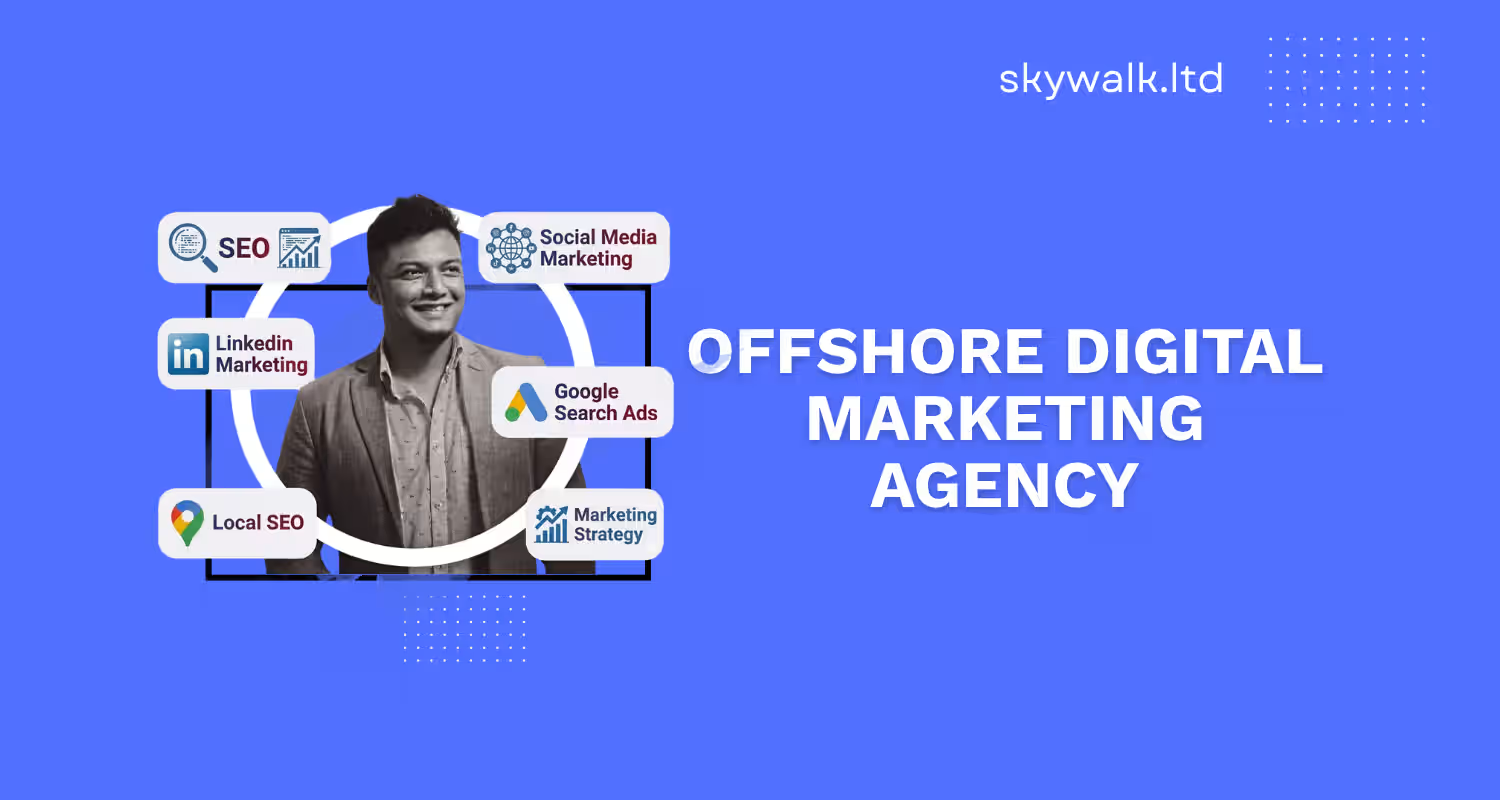

Partnering with an offshore digital marketing agency means hiring a specialist team outside your country to run core channels like SEO, PPC, content, and social—trading higher local costs for more execution capacity, but only if processes, communication, and market understanding are handled carefully. SkyWalk operates from Bangladesh with a global client focus, and is structured to deliver that offshore execution while keeping strategy, reporting, and accountability clear.
Offshore Digital Marketing Agency for Businesses That Want More From Their Marketing Budget
If you’re reading this, you’ve probably already seen several agency pages promising “affordable, world‑class, results‑driven” offshore services. What you actually need to know is how offshore digital marketing works in practice, what it costs, what can go wrong, how to evaluate agencies, and whether a partner like SkyWalk is a realistic fit for your business.
SkyWalk is a strategic digital marketing agency headquartered in Dhaka, Bangladesh, with a registered presence in London, working with startups, SMEs, and enterprise clients worldwide across SEO, web development, social media, performance marketing, and conversion optimization. Our core point of view is that offshore should be judged not by hourly rates, but by how much qualified marketing output you get per dollar and how much management effort you must invest to make the relationship work.
We’ll walk through definitions, business models, workflows, comparisons with local and in‑house teams, pricing drivers, risks, evaluation criteria, and how an offshore engagement with SkyWalk actually runs—without inventing case studies or results. Where detailed SkyWalk evidence is needed but not available here, you’ll see explicit placeholders so you can plug in verified data later.

What Is an Offshore Digital Marketing Agency?
An offshore digital marketing agency is a company based in one country that delivers digital marketing services to clients in other countries, typically in higher‑cost markets like providing offshore digital marketing services for US business, digital marketing services for UK business, offshore digital marketing services for Europe, and digital marketing service for Dubai, UAE. Instead of hiring local staff, businesses outsource channels like SEO, PPC, social media, content marketing, and analytics to this remote team, who work through online collaboration tools and structured processes.
Global outsourcing of digital marketing is growing fast: one analysis estimates the digital marketing outsourcing market at about 17.1 billion USD in 2025, projected to more than triple by 2035. Offshore agencies sit inside that trend, offering clients access to lower‑cost but qualified talent in markets such as South Asia, Eastern Europe, and Latin America, often with strong English skills and platform expertise.
Agency vs freelancer
Freelancers usually handle narrow tasks (e.g., “write 4 blog posts” or “set up Google Ads”) with limited responsibility for overall strategy or results.
Offshore agencies combine multiple specialists—SEO, PPC, content, design, analytics—under one structure, with shared tools, reporting, and internal quality control.
The practical difference: a freelancer is a single resource you manage; an offshore marketing agency is a multi‑disciplinary team that should manage the day‑to‑day execution within agreed goals, KPIs, and a workflow.
Agency vs staffing company
Staffing companies supply individual offshore marketers or “virtual employees” who work inside your systems like staff, but you remain responsible for direction, process, and performance management. An offshore digital marketing agency, by contrast, owns the delivery model: strategy support, task planning, execution, reporting cadence, and often training and platform access.
If you want a managed service, agency is usually more suitable; if you want to build and run your own offshore department with tight internal control, a staffing partner or direct hiring may make more sense.
Agency vs local agency
Local agencies sit in your own country and share your time zone, legal environment, and market context; offshore agencies work remotely from a different country, often at lower cost.
Key trade‑offs:
Local agencies have direct local market exposure, in‑person meeting options, and often easier cultural alignment.
Offshore agencies trade that for more execution capacity and lower operating cost, provided they invest in serious market research and clear communication.
Agency vs in‑house team
An in‑house marketing team is hired as employees, paid local salaries, managed daily by your leadership, and embedded in your culture. Outsourcing to an offshore digital marketing company turns those functions into a service: you buy outcomes and capacity instead of individual hires.
In‑house usually wins on deep brand understanding and cross‑department alignment; offshore wins on specialist access, variable cost, and speed of scaling up or down. Your decision comes down to which mix of control, cost, and capacity you need.
Read more about our social media marketing services in Dubai and digital marketing agency for startups in Dubai.
Also learn more about our real estate social media marketing agency Dubai and remote digital marketing agency service in UK.
Why Businesses Hire Offshore Digital Marketing Agencies
Businesses rarely go offshore “just because it’s cheaper.” They are usually reacting to pressure on budgets, hiring, speed, or specialist capacity. Surveys of marketing leaders show that more than 60% have outsourced some digital work to external partners to access expertise and manage resource constraints.
Here are the actual reasons we see companies exploring offshore digital marketing services:
Agency overhead and cost pressure. Local agencies in US/UK markets often charge several thousand dollars per month per channel; offshore partners in reputable markets can deliver SEO, PPC, or social retainers for a fraction of that, depending on scope and complexity.
Specialist access. Roles like technical SEO, CRO, or performance media buying are expensive and hard to hire locally; offshore SEO agencies and offshore PPC agencies aggregate these specialists and make them available to smaller budgets through shared teams.
Scalability and execution capacity. Offshore marketing teams make it possible to increase content output, launch more ad experiments, or roll out multi‑language campaigns without hiring a large in‑house department.
Flexibility. Outsourced digital marketing services allows businesses to ramp activity up or down more quickly in response to seasonality, funding changes, or new product launches than most local hiring markets allow.
International campaigns. When you’re targeting multiple regions, it can be more efficient to centralize campaign execution in one offshore hub that coordinates localized research and creative.
Time‑zone advantages—and friction. Offshore can create extended working days: for example, a Bangladesh‑based team can work while US clients are offline, which can accelerate production; but misaligned time zones require stronger planning and intentional overlap hours to avoid delays.
The underlying business question is: “Can I get more qualified marketing output for the same or lower budget without creating new management headaches?” Offshore can be a good answer, but only when process and expectations are clear.

Our Experience Running Offshore Digital Marketing Campaigns
SkyWalk is a Dhaka‑based agency with a presence in London, focused on SEO, social media, performance marketing, and web development for global and Bangladeshi brands. That means offshore delivery is part of our daily work: we coordinate with clients in different time zones, navigate remote collaboration, and run campaigns where strategy and execution sit in different cities.
From that operating reality, several patterns shape how we design offshore engagements:
International clients expect clarity on ownership. When strategy, execution, approvals, and reporting do not have clear owners, small questions can turn into stalled campaigns. We structure our engagements so every key area—SEO roadmap, ad optimization, content calendar, reporting—is explicitly assigned.
Communication friction shows up first in approvals and hand‑offs. The riskiest moments in offshore work are when tasks move from “planned” to “approved” to “published.” Without a predictable approval window and a single source of truth (project tool plus reporting), campaigns drift or launch late.
Data and tracking reduce remote uncertainty. Because we position ourselves as ROI and ROAS‑driven, our processes emphasize tracking audience data and retargeting performance, so clients can see what is happening without relying on long narrative updates.
To make this section fully experience‑led, you can later add real SkyWalk stories using the framework below:
Until those are added, we focus on transparent patterns rather than invented examples.
How Our Offshore Digital Marketing Agency Works
The offshore model only works when the workflow is explicit. Below is a practical view of how a typical engagement with SkyWalk is structured—from discovery to ongoing optimization.
Understand the Business
We start by understanding how your company makes money, who your customers are, what channels already drive results, and what constraints you face (budget, resources, compliance). This includes reviewing your product or service, sales cycle, and internal marketing capacity.
Key questions:
What outcomes matter most—leads, sales, qualified traffic, retention?
Which markets and languages do we need to consider?
Which internal stakeholders must be involved in marketing decisions?
Audit Existing Marketing
Before proposing offshore digital marketing services, we audit current assets and performance:
Website and landing pages (technical health, UX, conversion paths).
Analytics and tracking setup (GA, tag managers, pixel data).
SEO performance (indexation, keyword footprint, backlink profile).
PPC accounts (Google Ads, Meta Ads, LinkedIn, etc.).
Content and social presence.
This audit tells us what is already working, where you’re leaking value, and where offshore execution can realistically move the needle.
Build the Strategy
We then map the strategy across channels, aligning with your goals and budget:
Decide which channels we will own (e.g., SEO + Google Ads + content) and which stay in‑house or with other vendors.
Define KPIs and timelines—traffic, leads, CAC, pipeline metrics, organic visibility—appropriate to your industry and maturity.
Prioritize quick wins vs longer‑term foundations (e.g., technical SEO fixes vs authority building).
Strategy is where offshore vs local/in‑house decisions are made; we recommend keeping core business positioning and brand voice direction on the client side, while we own channel mechanics and execution.
Build the Offshore Workflow
Next, we design the offshore marketing workflow so remote work feels predictable, not chaotic:
Choose collaboration tools (e.g., project management, file sharing, chat).
Define meeting rhythm (weekly or bi‑weekly performance reviews; monthly strategy reviews).
Specify approval SLAs—how long we expect content, ads, or experiments to wait for client approval.
Set reporting cadence and format, so you know in advance what data you’ll see and when.
We treat offshore not as “cheap remote work,” but as a structured workflow that can integrate with your internal team.
Execute and Test
Once strategy and workflow are agreed, we move into execution:
Implement technical fixes and tracking.
Set up or restructure campaigns in Google Ads, Meta, and other platforms.
Produce content (articles, landing pages, creatives) aligned with the brief and SEO/PPC strategy.
Launch tests—ad variations, landing page experiments, new keyword sets.
Execution under an offshore model emphasizes repeatability: documented processes, checklists, and standard operating procedures so quality does not depend on one person.
Measure and Improve
Finally, we continually measure and refine:
Weekly or monthly performance reports with clear commentary, not just screenshots.
Identification of winning and losing experiments, with proposed next actions.
Regular review of KPIs vs targets, and course corrections when needed.
Offshore does not mean “set and forget.” It works when you see clear numbers, understand what’s happening, and can influence priorities without micro‑managing every task.

Offshore Digital Marketing Services We Provide
SkyWalk’s service mix is broad—SEO, web development, social media marketing, branding, and performance marketing—and all of it is shaped for offshore delivery. Below is how the offshore model changes each major service.
Offshore SEO Services
An offshore SEO agency model allows you to centralize technical audits, content optimization, and link acquisition in a lower‑cost market while still targeting US, UK, or other international search results.
Offshore impacts SEO in several ways:
More hours for research and optimization per budget unit.
Ability to maintain a steady content and technical optimization cadence instead of sporadic fixes.
Need for strong market research to understand local search behavior, competitors, and SERPs in your target country.
Clients should keep key brand messaging and expert inputs in‑house, while the offshore SEO team manages keyword research, on‑page optimization, and technical health.
Offshore PPC and Google Ads Services
Offshore PPC agencies manage search and social ad accounts, focusing on bid strategies, audience targeting, creative testing, and budget allocation.
In practice, offshore PPC services can:
Stretch testing budgets by lowering management fees, allowing more ad variants and audiences.
Run campaigns during your off‑hours when time zones align, making optimization more continuous.
Require disciplined communication to ensure that messaging and compliance reflect local regulations and cultural norms.
Clients should keep offer strategy, legal constraints, and positioning close, while letting offshore specialists handle daily optimization and reporting.
Offshore Content Marketing
Offshore content marketing teams produce and optimize content at scale—articles, landing pages, emails, and sometimes scripts or creative assets.
Offshore changes content marketing economics:
Lower production cost per piece lets you test more topics and formats.
You can build content clusters more quickly to support SEO and lead nurturing.
However, subject‑matter depth and cultural nuances must be protected through good briefing, review processes, and possibly local subject experts.
We recommend keeping final editorial authority and specialist insights in‑house, while using offshore writers and strategists for structured content execution.
Offshore Social Media Marketing
Offshore social media marketing teams handle content calendars, creative production, community responses (within guidelines), and paid social campaigns.
The key offshore considerations:
Time zones affect real‑time community management; plan escalation rules for sensitive issues.
Brand voice must be documented clearly; offshore teams should not improvise tone for reputation‑critical brands.
Offshore can be effective for planned content and paid campaigns, while local teams might retain control of high‑risk public communications.
Conversion Rate Optimization (CRO)
Offshore CRO blends analytics, UX, development, and testing to improve how visitors convert on your site or landing pages. This requires coordination between analysts, designers, and developers.
Offshore delivery can make CRO more affordable and iterative:
More experiments per month for the same budget.
Easier access to implementing small UX and copy changes.
Need for structured testing frameworks so experiments are valid and aligned with business goals.
Sensitive funnels (regulated industries, complex B2B) may need closer in‑house or local oversight on messaging and risk.
Analytics and Marketing Reporting
Offshore digital marketing agencies often own analytics implementation and reporting dashboards: setting up tracking, building reports, and explaining performance.
Done well, offshore analytics teams:
Standardize measurement across channels.
Reduce reliance on manual reporting.
Give stakeholders simple visibility into what the offshore team is doing and achieving.
Clients should retain admin access and data ownership, while offshore teams build and maintain the measurement stack.
Offshore vs Local Marketing Agency: Which Is Better?
There is no universal winner. Offshore vs local agencies trade off cost, communication, access, and local knowledge. The right answer depends on your business model and tolerance for remote collaboration.
Key dimensions
When a Local Marketing Agency Makes More Sense
Choose a local agency when:
Your marketing relies heavily on in‑person events, local networking, or physical experiences.
You need frequent on‑site meetings or workshops.
Your brand is early‑stage and positioning is still fragile; real‑time collaboration is critical.
Regulatory or compliance requirements demand close local oversight.
When an Offshore Digital Marketing Agency Makes More Sense
Choose an offshore digital marketing agency when:
You have clear digital goals but limited budget for local hires or agencies.
You need more execution capacity across SEO, PPC, content, and analytics than a small in‑house team can handle.
Your product is digital‑first and can be marketed effectively through remote research and optimization.
You’re comfortable working through structured remote processes and tools.
Why We Do Not Pretend to Be a Local Agency
A good offshore agency should not pretend to be local; it should prove market understanding through research, process, and results. SkyWalk is explicitly based in Bangladesh with a London presence; we don’t present ourselves as “down the street” from clients, because the value we offer is structured global execution from an offshore hub.
Instead of trying to mimic local agencies, we focus on:
Strong discovery and research into your specific market.
Clear communication rhythms that respect time zones.
Transparent reporting so distance does not feel like opacity.

Offshore vs In‑House Digital Marketing Team
Offshore vs in‑house is a bigger decision than “agency vs agency.” It affects hiring, management, culture, and cost structure.
Key comparison areas
Hiring and recruitment. In‑house teams require local recruitment, employer branding, and ongoing HR; offshore agencies bring ready‑made teams you don’t need to hire individually.
Salaries and benefits. US or UK digital roles can cost 65–90k USD per year; offshore equivalents in qualified markets can be roughly one‑third of that, according to some industry benchmarks.
Management load. In‑house staff need daily management, performance reviews, and career paths; offshore agencies are managed at the engagement level, with the agency handling internal staffing and training.
Specialist access. It’s hard to justify hiring a full‑time CRO specialist or senior technical SEO early; offshore digital marketing outsourcing can give you fractional access to those skills.
Scalability. Scaling in‑house takes months; offshore services can expand scope much faster, within contract limits.
Software and tools. In‑house teams may need licenses for everything; offshore agencies often include tool access in their fees.
Retention and risk. Employee churn hurts continuity; offshore agencies absorb staff changes internally and maintain process continuity.
In‑house teams work best when marketing is strategic, cross‑functional, and central to business differentiation. Offshore agencies work best when you need reliable execution against a clear strategy and don’t want to build a large internal department yet. Many companies use a hybrid: in‑house leadership plus offshore execution.
How Much Does Offshore Digital Marketing Cost?
Costs vary widely. It’s misleading to quote a single number, because pricing depends on scope, team size, markets, and required expertise. However, credible industry sources give ranges that illustrate the gap between onshore and offshore.
Pricing drivers
Channels included (SEO, PPC, social, content, CRO, analytics).
Number of markets and languages.
Content volume and complexity.
Ad spend and platforms.
Required reporting and strategy involvement.
Level of seniority in the team.
Some benchmarks for SMEs in 2025:
Offshore SEO retainers often fall in the range of approximately 800–2,000 USD per month, while similar onshore US/UK retainers run several times higher.
Offshore PPC management can range around 600–2,000 USD per month depending on platforms and creative testing cadence, compared with 2,500–8,000 USD or more onshore.
Offshore social media and content production follow similar patterns, with offshore often 40–70% cheaper for equivalent scopes.
Model comparison
Rather than chasing the lowest monthly fee, compare:
Freelancer. Lowest cost; narrow scope; you manage strategy and coordination.
Specialist consultant. Higher rates; deep expertise; limited capacity.
Offshore agency. Moderate fees; broad team; structured reporting and execution.
Dedicated offshore team. Higher but still below local; behaves like your own department.
In‑house team. Highest total cost once salaries, tools, and overhead are included.
Local agency. Higher fees; strong local insight and proximity.
The real comparison is “qualified outputs per dollar” and “management time per result,” not headline hourly rates.
Learn more about cost of hiring a remote marketing agency.
How We Manage US and International Marketing From Bangladesh
SkyWalk operates primarily from Dhaka, Bangladesh, with a registered London address, and works with international brands. That means we must prove market understanding rather than assuming it. Being offshore does not automatically make us experts in your local market; we build that expertise systematically.
Key elements of our approach:
Market research. We analyze local SERPs, competitor strategies, customer reviews, and industry publications in your target country to understand how buyers search and what they expect.
Local search behavior and SERPs. We study how queries differ region to region, which intent types dominate (informational vs transactional), and which competitors own the results you care about.
Language and nuance. For English‑speaking markets, we ensure copy and messaging reflect local phrasing; for other languages, we either collaborate with native speakers or keep offshore work focused on technical and structural tasks.
Time‑zone planning. Bangladesh’s time zone means partial overlap with Europe and limited overlap with US West Coast. We plan meeting windows and approval cycles accordingly so campaigns do not stall.
We do not claim automatic “local insight” into every market; instead, we combine research, client input, and ongoing performance analysis to refine understanding over time.
What Working With Our Offshore Marketing Team Looks Like
To make offshore feel predictable, you should know what day‑to‑day collaboration with SkyWalk looks like. While the exact plan varies by client, the core experience follows this pattern:
Kickoff and alignment. We hold an initial strategy and technical kickoff to review goals, current performance, assets, and constraints.
Task management. Work is tracked in a shared project management tool; you can see tasks, owners, and status without chasing email threads.
Approvals. Content and creatives go through a clear approval workflow with agreed timelines; we flag delays that might affect launch dates.
Meetings. We run fixed‑cadence calls (e.g., weekly performance reviews, monthly strategy sessions) that focus on decisions and next steps, not just reporting numbers.
Reporting. You receive structured reports with commentary, not just dashboards—explaining what happened, why, and what we plan next.
Escalation. Issues (performance drops, technical problems, misalignment) have defined escalation paths so they are handled quickly.
Offshore does not mean “hands‑off.” Clients who engage, give feedback, and maintain ownership of core business decisions get the best results.
Who Should Hire an Offshore Digital Marketing Agency?
Offshore tends to work best for certain types of businesses:
Digital‑first companies. SaaS, e‑commerce, online services, and content businesses that already operate online and can be understood from afar.
International companies. Brands targeting multiple regions where centralized execution makes sense.
Companies needing specialist skills. Teams that cannot justify hiring full‑time specialists for each channel but still need strong SEO, PPC, CRO, and analytics.
Companies needing scalable execution. Organizations with clear roadmaps that struggle to keep up with content, campaigns, and optimization.
Companies sensitive to agency overhead. Businesses that want more marketing horsepower without building large local teams or paying top‑market agency rates.
If you recognize yourself in these descriptions and can work comfortably through structured remote workflows, offshore is worth serious consideration.
Who Should NOT Hire an Offshore Digital Marketing Agency?
This section is mandatory because honesty builds trust. Offshore is not right for everyone.
You should be cautious—or avoid offshore entirely—if:
Physical presence is central to marketing. If your marketing relies on local events, trade shows, physical activations, and in‑person sales support, a local or in‑house team will likely serve you better.
Local networking is a primary growth lever. Industries where relationships are built through local chambers, meetups, and community presence may not benefit much from remote execution.
In‑person production is core. Brands that require frequent on‑site photo/video shoots, store visits, or location‑specific creative will find remote teams limited.
Remote collaboration is culturally unsuitable. If your leadership prefers ad‑hoc, in‑person decision‑making over structured calls, offshore can feel frustrating.
In these situations, offshore can still play a role in back‑end tasks (technical SEO, analytics, reporting), but should not be the primary marketing engine.
How to Choose the Right Offshore Digital Marketing Agency
Choosing an offshore marketing agency is not just about reading a services list. You need a practical evaluation framework that goes deeper than “experienced, results‑driven, full‑service.”
Key evaluation points:
Actual experience. Ask for case studies aligned to your industry or channels, with clear goals, actions, and outcomes; verify details rather than accepting vague claims.
Team structure. Understand who will do the work—senior strategists, channel specialists, generalists—and whether they are employees or subcontractors.
Who performs the work. Clarify whether the people you meet during sales will be involved later or if the work is handled by a separate production team.
Communication and reporting. Evaluate tools, meeting cadence, and report quality; ask to see sample reports and project snapshots.
Pricing and scope. Compare not just monthly fees but what is included: number of campaigns, content pieces, experiments, and hours.
Quality control. Ask how they review work internally—peer review, senior oversight, QA checklists.
Contracts and security. Ensure data access, confidentiality, and termination clauses are clear; offshore does not remove your responsibility to protect customer data.
Strategy and accountability. Clarify whether they will help shape strategy or only execute tasks; make sure KPIs and responsibilities are written down.
Client references. Ask for references you can actually contact, or verified reviews on independent platforms like Clutch or similar.
One practical exercise: request two anonymized case studies and a sample reporting pack for similar work, then compare those across shortlisted agencies.
Common Offshore Digital Marketing Mistakes
Many offshore marketing relationships fail not because offshore is inherently weak, but because common mistakes go unaddressed. Some of the most damaging errors include:
Choosing only on price. Focusing on the lowest fee often leads to under‑resourced teams, weak processes, and poor quality; this can waste more budget than it saves.
Poor briefing. Without clear goals, audience definitions, and brand guidelines, offshore teams make assumptions that lead to misaligned campaigns.
Unclear ownership. If no one owns strategy, approvals, and reporting, responsibility gets diluted and issues stay unresolved.
Weak communication. Infrequent or unstructured communication lets small misunderstandings grow into structural problems.
Lack of market research. Treating all markets as identical ignores local search behavior, competition, and customer expectations.
Measuring vanity metrics. Focusing on impressions, clicks, or follower counts instead of meaningful KPIs (qualified leads, sales, CAC) can hide underperformance.
Expecting immediate results. SEO, CRO, and complex funnels take time; expecting rapid ROI from foundational work sets the relationship up to fail.
Outsourcing strategy without oversight. Fully delegating strategy to an offshore partner without internal review reduces your control over positioning and priorities.
Failing to define KPIs. Without clear metrics and targets, neither side can fairly judge success or failure.
Avoiding these mistakes requires intentional setup, not just a contract and kickoff call.
Frequently Asked Questions About Offshore Digital Marketing Agencies
What is an offshore digital marketing agency?
It is a marketing agency based outside your home country that manages digital channels such as SEO, PPC, social media, content, and analytics for your business through remote collaboration.
Is offshore digital marketing cheaper?
Often yes—labor and overhead costs in offshore markets are lower, so monthly retainers and team costs can be significantly reduced compared to US or UK equivalents. But cheaper management fees do not automatically mean lower total marketing cost or better ROI; you must consider output quality, ad spend efficiency, and management time.
Are offshore marketing agencies good for US companies?
Offshore agencies can work well for US companies that have clear goals, can collaborate remotely, and want more execution capacity for their budget. The key is ensuring cultural fit, strong communication, and serious market research into US buyers and competitors.
What services can I outsource?
You can outsource SEO, PPC/Google Ads, social media management, content marketing, email marketing, basic CRO, and analytics/reporting to an offshore marketing team. Strategy direction and brand positioning are usually better kept close to your leadership.
How much does offshore digital marketing cost?
For SMEs, individual offshore channels (like SEO or PPC) often fall in the low thousands of dollars per month, while equivalent onshore retainers can be several times higher, depending on scope and complexity. Exact pricing depends on channels, markets, content volume, and required seniority.
Is offshore better than a local agency?
Offshore is better when you need more execution for less budget and can work well remotely; local is better when physical presence, local networking, and deep local insight are critical. Neither is automatically superior.
Is offshore better than hiring in‑house?
Offshore is better when you want variable cost, faster scaling, and access to multiple specialists without hiring them individually; in‑house is better when marketing is a core strategic function and you want tight internal control and cross‑department alignment.
How do offshore agencies handle time zones?
Good offshore agencies design overlapping hours, clear approval windows, and structured meeting rhythms so time zones create extended production time rather than delays. Poorly managed time zones, by contrast, lead to missed approvals and slow responses.
How do I choose an offshore marketing agency?
Evaluate experience, team structure, communication, reporting, pricing, quality control, contracts, security, and client references—not just their website copy. Ask for anonymized case studies and sample reports for similar work.
Can an offshore agency manage SEO and Google Ads?
Yes. Many offshore digital marketing companies, including SkyWalk, provide offshore SEO services and offshore PPC/Google Ads services as part of their core offering. The key is ensuring they understand your market and have clear processes for testing and optimization.
Is an Offshore Digital Marketing Agency Right for Your Business?
To decide, use a simple framework:
Choose offshore when…
You have clear goals and can collaborate via structured remote workflows.
You want more capacity across multiple digital channels without building a large in‑house team.
Your product can be marketed effectively through online channels and research.
Consider local when…
Marketing depends on in‑person presence, local networking, or frequent on‑site collaboration.
You operate in highly localized niches where nuance outweighs pure digital execution.
Consider in‑house when…
Marketing is central to your differentiation and requires deep integration with product, sales, and leadership.
You can afford and manage a team of specialists over the long term.
Consider hybrid when…
You want in‑house leadership and brand guardianship, with offshore agency or team handling channel execution and reporting.
SkyWalk fits best into the offshore/hybrid box: we act as a remote execution and optimization engine for businesses that want more from their marketing budget and can work through a transparent offshore delivery model.
Work With SkyWalk as Your Offshore Digital Marketing Partner
SkyWalk is a Dhaka‑based digital marketing agency with a London presence, specializing in SEO, web development, social media marketing, branding, and performance marketing for global and Bangladeshi brands. We deliver offshore digital marketing services through a structured workflow designed for international clients who want more execution capacity, clear reporting, and ROI‑focused campaigns.
If you’re considering an offshore digital marketing agency, the next practical step is to assess whether your goals, constraints, and working style match this model.
Get an Offshore Marketing Assessment
Share your current marketing setup, goals, and challenges. We’ll review where offshore can realistically help, where local or in‑house may be better, and outline what an engagement with SkyWalk would look like—without pressure to commit before the model is clearly understood.
Sources and referrences:
- https://www.designrush.com/agency/profile/skywalk
- https://clutch.co/profile/skywalk
- https://www.versatile.club/blogs/offshore-digital-marketing-guide/
- https://www.versatile.club/blogs/what-are-offshore-digital-marketing-services-a-2025-complete-guide-for-smes/
- https://market.us/report/digital-marketing-outsourcing-market/
- http://blog.ablysoft.com/how-to-choose-the-right-offshore-digital-marketing-agency/
- https://www.marketingweek.com/outsourcing-rising-digital-expertise/
- https://www.linkedin.com/company/skywalk-solutions
- https://skywalk.ltd/best-digital-marketing-agency-in-bangladesh/
- https://www.zoominfo.com/c/skywalk/547322552
- https://www.studocu.com/row/document/north-south-university/business-communication/local-case-finance/8777753