
A SkyWalk campaign case study — UCB Asset Management Limited · YouTube + Google Display · October 2025
Written by the SkyWalk performance team. We’re a Google-certified agency in Dhaka, and everything below comes straight out of the live Google Ads dashboards we managed for this campaign — not a template, not a “sample report,” and definitely not a screenshot we borrowed from someone else’s LinkedIn.
The brief: sell patience to a country that loves the Skip button
Let’s start with an uncomfortable truth that everyone in Bangladeshi marketing knows but nobody puts on a slide: the Skip Ad button might be the single most-clicked button in this country. We have collectively trained our thumbs to find it before the ad even finishes saying “Hi.”
So when UCB Asset Management Limited — one of the country’s serious players in mutual funds and wealth management — came to us, the challenge wasn’t “get views.” Views are easy to buy. The challenge was getting the right people to actually stop, watch, and absorb a message about long-term investing — a topic that, let’s be honest, competes for attention against cat videos, cricket highlights, and your cousin’s wedding vlog.
Two things made this genuinely hard, and we’d rather tell you the truth than pretend it was a victory lap from minute one:
First, investing is a low-frequency, high-trust decision. Nobody opens YouTube planning to buy a mutual fund. You’re planting a seed, not closing a sale.
Second, the Bangladeshi audience is not one audience. The 24-year-old watching a music video and the 42-year-old reading share-market news on his phone at 11pm are two completely different humans with two completely different devices, two different moods, and two very different relationships with money. Treating them as one blob is how agencies quietly waste budgets.
We set two clear, measurable targets up front — the kind you can actually be held to:
- YouTube: 80,000 video views (plus impressions, marked politely as “tentative,” which is industry-speak for we’re confident but we’re not your fortune teller).
- Google Display: 1,167,000 impressions (plus clicks, also “tentative”).
How we did it: one client, two channels, two completely different game plans
Here’s the part most “we ran some ads” stories skip over. We didn’t run one campaign in two places. We ran two deliberately different campaigns because the data told us the audiences would behave differently — and they did, almost comically so.
On YouTube, we went for attention and storytelling.
We built the campaign around a 2-minute-38-second responsive video ad featuring popular actor Zahid Hasan as the face of the message. That length is a deliberate, slightly risky choice — conventional wisdom screams “keep it under 30 seconds.” But for a trust product like asset management, a familiar face and a proper narrative (“plan ahead, get expert advice, and investing stops being scary”) earns the kind of watch-time that a quick punchy clip never will. We were essentially betting that a good story beats the Skip button. We’ll show you how that bet paid off in a moment.
On Display, we went for reach and presence.
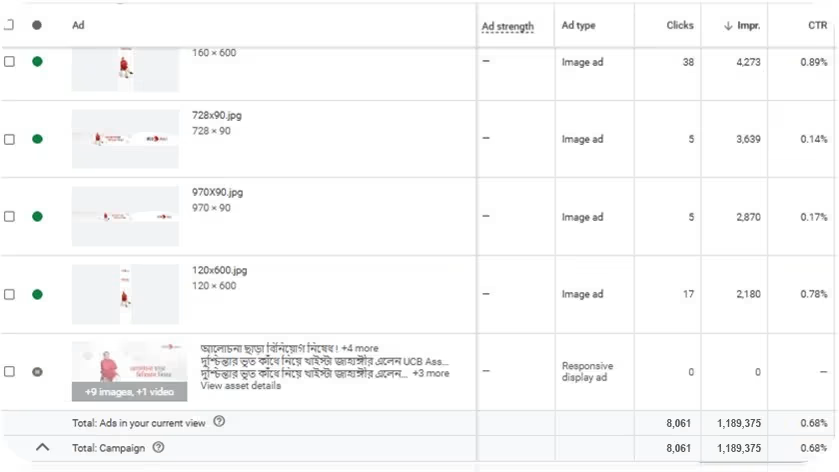
We ran a full kit of banner formats — the tall 160×600 and 120×600 skyscrapers, the wide 728×90 and 970×90 leaderboards — plus a responsive display ad loaded with 9 images and a video, so Google’s machine could mix and match across every screen size on the network. The goal: be everywhere UCB’s prospective investors already spend time online, without being annoying about it.
And critically, we let context do the targeting heavy-lifting. Rather than just shouting at a broad demographic, we leaned into Bangladesh’s actual media diet — the national news channels, the business and share-market sites, the entertainment platforms — so the ads showed up where money-minded people already live online.
What we learned: the two audiences were almost mirror images of each other
This is the part we genuinely enjoyed, because the dashboards confirmed something we suspected but couldn’t have proven before spending a taka.
Lesson 1 — YouTube and Display reached two different generations.
On YouTube, our biggest engaged group was the 25–34 crowd, with 35–44 close behind. On Display, the picture flipped: clicks were dominated by the 35–44 group, followed by 45–54 — in other words, the people most likely to actually have money to invest right now. Same brand, same week, two different life-stages reached on purpose. If we’d run one generic campaign, we’d have blurred both.
Lesson 2 — Bangladesh watches YouTube on the big screen, and clicks Display on the small one.
This one made us put our chai down. On YouTube, 54.9% of paid views came from TV screens — connected TVs in living rooms — with computers next. Turns out a huge slice of the country now watches YouTube the way we used to watch BTV: on the big screen, with the whole family quietly judging the ad. But on Display, 96.5% of clicks came from mobile phones. TV screens contributed effectively zero Display clicks (you can’t tap a banner on a television, and nobody tries). So: awareness happens on the sofa; action happens in the palm of your hand. We’ve stopped treating “device” as a footnote and started treating it as strategy.
Lesson 3 — vertical banners quietly outwork horizontal ones.
A small, nerdy, money-saving finding: our tall skyscraper banners (160×600 at 0.89% CTR, 120×600 at 0.78%) comfortably beat the wide leaderboards (728×90 at 0.14%, 970×90 at 0.17%). Horizontal banners are easy to scroll past; vertical ones sit alongside content where the eye actually lingers. We now weight creative production accordingly instead of producing every size equally “to be safe.”
Lesson 4 — context beats volume.
Some of our strongest engagement came from contextually relevant inventory, not just high-traffic inventory. On Display, a share-market news site (sharenews24.com) and business dailies pulled meaningfully higher click-through than generic placements; we even surfaced on a bank-loan EMI Calculator app. On YouTube, a finance-themed “Trading Chart” placement landed alongside the news channels. For an asset manager, showing up next to share-market content isn’t a coincidence — it’s the whole point.
Our findings: the numbers, with nothing rounded up to flatter ourselves
We’ll let the dashboards talk. These are the actual end-of-campaign figures.
YouTube Skippable (TrueView) — target: beaten.
We promised 80,000 views and delivered 92,714 genuine TrueView views — about 16% over goal — alongside 314,774 impressions. The view rate landed at 17.00%, which for a skippable ad in a Skip-happy market is a strong number: roughly one in six people who could have skipped chose to keep watching Zahid Hasan instead. The average CPM came in at $0.33, and the entire YouTube campaign cost $632.17 — which works out to less than one US cent per view. The long-form storytelling bet held.
Google Display — target: beaten.
We promised 1,167,000 impressions and delivered 1,189,375 impressions with 8,061 clicks at a 0.71% CTR — a healthy click-through for display banners, which are famous for being ignored. Average viewable CPM was $0.53, total spend $548.58, landing each click at roughly 7 US cents.
Put together: across both channels we delivered over 1.5 million impressions, 92,700+ video views, and 8,000+ clicks for a combined media spend of about $1,180 — genuinely close to the price of a single mid-range phone, which is poetic, because most of those Display clicks happened on mid-range phones.
Why this is the opposite of “just boost the post”
We’ll say the quiet part out loud, because it’s the real lesson. A lot of “digital marketing” in Bangladesh still means tapping the blue Boost button under a Facebook post and hoping. That gets you reach. It does not get you a TV-screen vs mobile insight, an age-split between awareness and action, a placement-level read on which finance sites convert, or a creative-format finding you can reuse on the next campaign.
What made this work wasn’t a secret hack. It was treating two audiences as two audiences, matching the message to the device, leaning on context, and then actually reading the dashboard afterward instead of just exporting it. That’s the difference between buying impressions and building a system you can repeat.
What we’d do next (because honest case studies don’t end at “and everyone lived happily ever after”)
For the next flight we’d shift more Display budget toward the high-CTR vertical formats and the finance-context placements that earned their keep, tighten YouTube delivery around the connected-TV and 35–44 sweet spot for the higher-intent message, and layer in remarketing so the people who watched 2 minutes and 38 seconds of our ad get a gentle, well-timed nudge to actually book that appointment. Awareness was the win this round. Conversion is the next mountain, and we already know which trail to take.
Want to get similar results?
SkyWalk can help build your brand through multiple channels. Let’s talk about how the Best Digital Marketing Company in Bangladesh can work for your business.
SkyWalk is a Google-certified digital marketing and SEO agency based in Gulshan, Dhaka. The figures in this case study are taken directly from the live Google Ads campaign dashboards we managed for UCB Asset Management Limited in October 2025. We don’t publish numbers we can’t screenshot.